
German Potato Salad: The Traditional Recipes from North to South
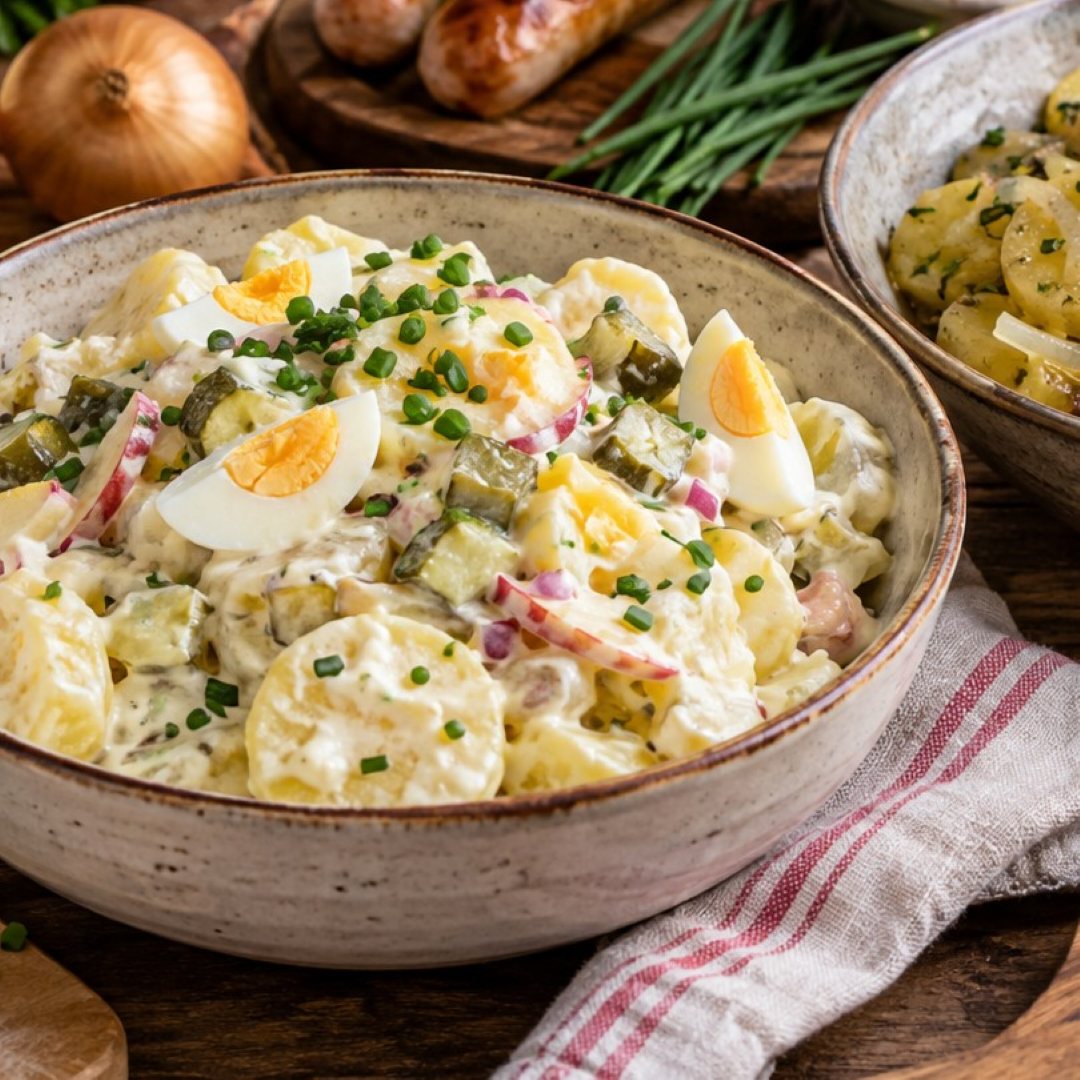
Traditional German potato salad
Ask someone in Germany what German potato salad is, and you may get a very confident answer.
Ask someone from another part of Germany the same question, and you may get a completely different one.
For some people, German potato salad means a creamy salad made with mayonnaise, pickles, onions and sometimes eggs or apples. For others, mayonnaise has absolutely no place in it. Their potato salad is made with warm potatoes, broth, vinegar, oil and onions, and it should be wonderfully schlotzig — a German word often used to describe the soft, moist and lightly creamy consistency of a good southern-style potato salad.
Both are German. Neither is simply “the” German potato salad.
That is what makes this humble dish so interesting.
Across Germany, potato salad reflects regional cooking traditions, local ingredients and, perhaps most importantly, family habits. Recipes can change from one town to the next, and sometimes even from one household to another. There is no single recipe book that can settle every argument about what belongs in a proper Kartoffelsalat.
What can be said with confidence is that potato salad has become one of Germany’s best-known everyday and festive side dishes — served at family gatherings, barbecues, celebrations, restaurants and, for many households, on Christmas Eve.
So, what exactly is German potato salad?
The answer depends very much on where in Germany you are.
What Is German Potato Salad?
German potato salad, or Kartoffelsalat, is a salad made primarily from cooked potatoes and a dressing or marinade. Beyond that basic definition, almost everything is open to regional interpretation.
The potatoes are generally firm-boiling or waxy varieties because they hold their shape better when sliced and mixed with the dressing. Some recipes use slightly flourier potatoes, particularly when a softer, more bound consistency is desired.
From there, German potato salad generally falls into two broad traditions:
Northern and northwestern German potato salad is often creamy and mayonnaise-based.
Southern German potato salad is usually made without mayonnaise and instead relies on broth, vinegar and oil.
But even that distinction is only a starting point. German potato salad has countless regional and family variations.
In the Rhineland, for example, apples and pickles may appear in mayonnaise-based versions. In northern Germany, cooked eggs and apples are common additions. Brandenburg has its own combinations involving pickles, radishes and onions. Southern recipes may include mustard, chives, cucumber, bacon or other ingredients depending on the area and the cook.
That variety is not a sign that one recipe is more authentic than another.
Quite the opposite.
It is part of what makes Kartoffelsalat so traditionally German.
North and South: Two Very Different Ideas of Potato Salad
The easiest way to understand German potato salad is to imagine a culinary line running roughly across the country.
It is not a precise geographical border, and there are plenty of exceptions. Still, there is a clear difference between the mayonnaise-based tradition found in much of northern Germany and the broth-and-vinegar tradition of southern Germany.
The contrast can be surprisingly dramatic.
One salad may be rich, creamy, cool and almost reminiscent of a delicately seasoned potato coleslaw.
The other can be warm or lukewarm, tangy, glossy and deeply savory, with the potatoes absorbing the broth and vinegar as they are mixed.
Both begin with potatoes.
After that, they go in very different directions.
Northern German Potato Salad
In northern Germany, a classic potato salad is often served cold and dressed with mayonnaise.
This style is especially familiar at family gatherings, summer parties and festive meals. Depending on the recipe, the mayonnaise may be used on its own or softened with yogurt, sour cream, mustard or pickle juice.
Typical ingredients include:
- waxy potatoes
- mayonnaise
- pickles
- onions
- hard-boiled eggs
- apple
- mustard
- pickle brine
- salt and pepper
Not every recipe contains all of these ingredients.
That is important.
A northern German family recipe might contain apple but no egg. Another might contain egg but no apple. One family may insist on plenty of pickles, while another barely uses any. Some recipes are very creamy; others deliberately keep the mayonnaise relatively light.
German cooking has always allowed considerable room for household interpretation.
A common approach is to cook the potatoes in their skins, allow them to cool, peel them and then slice them. The dressing is prepared separately before everything is gently combined and left to rest.
That resting period matters.
Potato salad often tastes better after the potatoes have had time to absorb some of the seasoning. A salad that seems slightly too sharp immediately after mixing can taste perfectly balanced an hour later.
And there is another useful trick that appears in many German recipes: pickle brine.
A spoonful or two of the liquid from the pickle jar can add acidity, saltiness and a subtle sweetness while loosening a dressing that has become too thick.
It is an extremely simple ingredient, but one that can make a noticeable difference.
A Classic Northern German-Style Potato Salad
This is a traditional-inspired recipe rather than a claim that every northern German household prepares Kartoffelsalat this way. German recipes vary considerably from family to family.
Ingredients for 4–6 servings
- 1 kg waxy potatoes
- 150–180 g mayonnaise
- 3–4 tbsp pickle brine
- 120 g German-style pickles or gherkins
- 1 small onion
- 2 hard-boiled eggs
- 1 small tart apple
- 1 tsp mustard
- salt
- freshly ground black pepper
- a small pinch of sugar, if needed
- optional: chopped parsley or chives
Method
Cook the potatoes in their skins until tender but not falling apart. Drain them and allow them to cool enough to handle.
Peel the potatoes and cut them into slices. They should be thick enough to retain their shape rather than turning into mashed potatoes when mixed.
Finely dice the onion and pickles. Peel the eggs and cut them into small pieces. Core the apple and cut it into small cubes or thin slices.
For the dressing, mix the mayonnaise with the pickle brine and mustard. Season with salt and pepper and, if necessary, a very small amount of sugar.
Add the potatoes, pickles, onion and apple and gently fold everything together.
Finally, add the eggs carefully so they retain some shape.
Cover the salad and refrigerate it for at least one hour. Before serving, check the seasoning. If it has become too firm, add another spoonful of pickle brine.
The finished salad should be creamy, but not so heavily dressed that the potatoes disappear underneath the mayonnaise.
The Swabian Tradition: Kartoffelsalat Without Mayonnaise
Travel south into Swabia and you enter a completely different potato-salad world.
Here, the classic is Schwäbischer Kartoffelsalat, a dish based on potatoes, broth, vinegar and oil.
And yes, there is a strong regional feeling that mayonnaise simply does not belong.
A traditional Swabian potato salad is not supposed to be heavy or overloaded with dressing. Instead, the potatoes absorb a seasoned mixture of broth and vinegar, while the oil is incorporated at the end.
The result is moist and glossy, but not watery.
Swabians often describe the desired consistency as schlonzig or schlotzig — a difficult word to translate perfectly. “Creamy” is not quite right because there is no cream or mayonnaise involved. “Moist” does not capture it either.
It describes a potato salad with a soft, almost silky consistency in which the dressing clings to the potatoes.
That texture is one of the defining characteristics of the dish.
Regional recipes typically use firm-boiling potatoes, onions, broth, vinegar and oil. Mustard may be included, although recipes vary. Chives are also common in some versions.
The way the ingredients are combined is just as important as the ingredients themselves.
The potatoes should still be warm or at least lukewarm when they meet the dressing. This allows them to absorb the broth and vinegar more effectively. Bavarian and Swabian cooking advice frequently emphasizes this point.
Classic Swabian Potato Salad
Ingredients for 4–6 servings
- 1 kg firm-boiling potatoes
- 1 medium onion
- 250–350 ml strong vegetable or meat broth
- 4–5 tbsp white wine vinegar
- 4–6 tbsp neutral vegetable oil
- 1 tsp mustard, optional
- 1 tsp salt, plus more to taste
- freshly ground black pepper
- a small pinch of sugar
- chopped chives, optional
Method
Cook the potatoes in their skins until tender. Drain them and let them steam off for a few minutes.
While they are still warm enough to absorb the dressing, peel them and cut them into thin slices.
Finely chop the onion.
Warm the broth and season it with salt, pepper, vinegar and a small amount of sugar. Add mustard if using.
Pour some of the warm dressing over the potatoes and gently mix.
Do not add all the liquid at once.
Potatoes differ considerably in how much liquid they absorb, so add the broth gradually while carefully turning the potatoes. The goal is a moist, bound consistency rather than a bowl full of dressing.
Let the potatoes rest for several minutes.
Then add the oil and gently fold it through.
Taste again. A good Swabian potato salad should usually have a noticeable acidity, enough salt to bring out the potato flavor and enough broth to keep the salad succulent.
Finish with chives if desired.
Serve warm, lukewarm or at room temperature.
A traditional Swabian potato salad should never feel dry.
Why Warm Potatoes Matter
This is one of the small details that separates a good southern German potato salad from a disappointing one.
When potato slices are warm, they absorb the seasoned liquid more readily. The starch released from the potatoes also helps the dressing cling to the slices.
But there is a limit.
If everything is excessively hot and the potatoes are particularly soft, the salad can become overly soft or “batzig” — another wonderfully German word that is not exactly a compliment in this context.
One useful compromise is to work with potatoes and dressing that are warm or lukewarm rather than piping hot. Bavarian cooking advice specifically recommends this approach for obtaining an even flavor and good consistency.
There is also a practical lesson here:
Do not pour a fixed amount of broth into the bowl and assume every batch of potatoes will behave the same way.
Add it gradually.
Let the potatoes tell you when they have had enough.
Bavarian Potato Salad: Similar, But Not Identical
Bavarian potato salad belongs to the same broad southern tradition, but it should not simply be treated as a carbon copy of Swabian Kartoffelsalat.
Bavarian versions commonly use broth, vinegar and oil, and mustard is frequently found in recipes. Some versions include cucumber or pickles, onions or fresh herbs.
A Bavarian restaurant or home cook might therefore produce a salad that looks quite different from a very minimalist Swabian version.
For example, one Bavarian recipe from BR Fernsehen uses broth, mustard, vinegar, oil, onions and cucumber, demonstrating how easily fresh ingredients can become part of the basic southern formula.
The important point is that “Bavarian potato salad” does not describe one legally defined recipe.
It describes a culinary tradition with many local interpretations.
A Bavarian-Style Variation
For a slightly more generous Bavarian version, start with the Swabian recipe and add:
- 1 small cucumber, thinly sliced
- 1–2 tsp mustard
- chopped chives
- a little extra broth if needed
Some cooks also add finely chopped pickles.
The cucumber adds freshness and a subtle crunch, while mustard gives the broth-based dressing additional depth.
This is particularly good with grilled meat, sausages, roast pork or schnitzel.
What About Central Germany?
The north-versus-south distinction is useful, but Germany does not stop having interesting potato salads between Hamburg and Munich.
Central German recipes can combine elements from both traditions.
Mayonnaise-based salads are common in several regions, while broth-based salads also appear.
Brandenburg, for example, is associated with mayonnaise-style combinations featuring pickles, radishes and finely sliced onions. Other ingredients such as leftover roast meat, herring or herbs may also appear in regional and family recipes.
In other words, the map is not divided into two perfectly clean halves.
German potato salad is better understood as a collection of overlapping regional traditions.
That is also why arguing about the one “authentic” recipe usually misses the point.
Potato Salad Is a Family Recipe in Germany
Perhaps the most German thing about German potato salad is not a specific ingredient at all.
It is the fact that people often believe their family’s version is the correct one.
A grandmother may have added diced apple.
A father may have insisted on more mustard.
One household may use beef broth, another vegetable broth.
Some families boil the onions briefly in the broth before mixing them into the potatoes. Others use raw onions. Some add bacon. Others would consider bacon completely unnecessary.
Some recipes are served warm.
Others are refrigerated overnight.
Some are very acidic.
Others are mild and creamy.
And because Kartoffelsalat is such a familiar everyday dish, people tend not to think of these differences as “variations” when they grow up with them.
It is simply how potato salad is made.
That is why a German might taste a version prepared in another region and immediately notice that something is different.
The difference is often not technical.
It is memory.
The Christmas Connection: Potato Salad and Sausages on Christmas Eve
One of the best-known German potato-salad traditions takes place on December 24: Heiligabend, Christmas Eve.
For many families, the meal is remarkably simple:
potato salad, sausages and mustard.
Depending on the region, the sausages may be Wiener Würstchen, Bockwurst, Bratwurst or a local sausage variety.
The combination has a reputation for being almost deliberately uncomplicated. While the main Christmas meal may be served on December 25, many families prefer something that can be prepared ahead on Christmas Eve.
Kartoffelsalat fits that role perfectly.
It can be made hours earlier, and in many cases it benefits from standing for a while so that the flavors develop.
The Christmas Eve tradition is widespread, but its exact history is less straightforward than some popular explanations suggest. The idea that it simply comes from an old pre-Christmas fasting tradition is often repeated, but modern accounts also point to the dish’s practicality and its growing popularity in post-war Germany.
So there is no single explanation that needs to be attached to every German family’s Christmas dinner.
What matters is that the tradition has become deeply embedded in German food culture.
And there is something very practical about the combination.
The potatoes can be prepared in advance.
The salad can rest.
The sausages need little preparation.
And the cook can spend Christmas Eve doing something other than standing in the kitchen for several hours.
That practicality is perhaps very appropriate for a dish that has always been rooted in everyday cooking.
What Sausages Are Traditionally Served with German Potato Salad?
There is no single mandatory sausage.
Common choices include:
Wiener Würstchen
Thin, gently smoked sausages are probably the version many people outside Germany associate most strongly with the Christmas Eve tradition.
Bockwurst
A slightly more substantial boiled sausage, also commonly served with potato salad and mustard.
Bratwurst
In some families, grilled or pan-fried bratwurst is the preferred partner, particularly outside the classic Christmas Eve setting.
Saitenwürstle
In Swabia, fine sausages known as Saitenwürstle are a natural accompaniment to regional potato salad.
The combination of potato salad, sausage and mustard is simple for a reason: the creamy or tangy potato salad provides the carbohydrate-rich, savory base, while the sausage adds salt, spice and richness.
No elaborate sauce is required.
Which Potatoes Are Best for German Potato Salad?
The potato variety matters more than many people realize.
For most German potato salads, firm-boiling potatoes are the safest choice.
They retain their shape when sliced and mixed, which is particularly important in mayonnaise-based salads. For broth-based potato salads, they also prevent the dish from becoming an indistinguishable mass of broken potato pieces.
In Germany, potatoes sold specifically as Salatkartoffeln are often chosen for this reason.
The precise variety is less important than its cooking characteristics.
When shopping outside Germany, look for:
waxy potatoes, salad potatoes or firm-boiling potatoes.
Avoid very floury potatoes unless the recipe specifically calls for them.
There is one interesting exception: some cooks deliberately incorporate a small proportion of more floury potatoes to help create a slightly creamier consistency.
But for a first attempt, firm-boiling potatoes are the easiest choice.
Should You Peel the Potatoes Before Cooking?
For traditional German potato salad, cooking potatoes in their skins is usually the better method.
The potatoes are then peeled after cooking and sliced.
This helps them retain their flavor and structure and makes it easier to judge when they are properly cooked.
The most important thing is not to overcook them.
You want a potato that is tender enough to eat but still firm enough to slice cleanly.
A potato that falls apart in the saucepan will rarely produce beautiful slices in the salad bowl.
Warm or Cold: How German Potato Salad Should Be Served
The answer depends on the regional style.
Northern German potato salad
Usually served cold or well chilled.
This works naturally with mayonnaise-based dressings.
Swabian potato salad
Often served warm, lukewarm or at room temperature.
It is particularly good shortly after the dressing has been absorbed.
Bavarian potato salad
Often served lukewarm or at room temperature, although cold versions certainly exist.
There is no universal rule that German potato salad must be cold.
In fact, serving a warm southern German potato salad alongside freshly prepared sausages is one of the simplest and most satisfying ways to experience the dish.
Common Mistakes When Making German Potato Salad
German potato salad is simple, but simple food is often less forgiving than it looks.
1. Using the wrong potatoes
If the potatoes are too floury, they may break apart during mixing.
2. Overcooking the potatoes
You want tender slices, not mashed potatoes.
3. Adding too much dressing
This is particularly easy with mayonnaise-based salads. Start with less and add more if necessary.
4. Forgetting the resting time
Potato salad changes as it sits. The potatoes absorb seasoning and the flavors become more integrated.
5. Under-seasoning
Potatoes are naturally mild. They need enough salt and acidity to taste lively.
6. Adding all the broth at once
With southern-style potato salad, add the broth gradually. Different potatoes absorb different amounts of liquid.
7. Serving a southern-style salad completely dry
A good Swabian or Bavarian potato salad should be moist and glossy rather than crumbly or dry.
8. Treating one family recipe as the only authentic version
This may be the biggest mistake of all.
Germany has no single standardized Kartoffelsalat recipe.
German Potato Salad vs. American Potato Salad
For readers outside Germany, it is useful to understand that German potato salad is not simply the German equivalent of American potato salad.
There are similarities, particularly between creamy mayonnaise-based versions.
But southern German potato salad is fundamentally different from a cold mayonnaise-based salad.
The broth-based dressing creates an entirely different texture and flavor.
It is lighter in mouthfeel, sharper from the vinegar and more closely integrated with the potato itself.
The northern German version, on the other hand, can look much more familiar to someone accustomed to mayonnaise-based potato salad.
This is one of those cases where the name tells only half the story.
What Do Germans Serve with Potato Salad?
Potato salad is exceptionally versatile.
Depending on the region and season, it may accompany:
- Wiener Würstchen
- Bockwurst
- Bratwurst
- Saitenwürstle
- schnitzel
- roast meat
- grilled sausages
- fried fish
- baked fish
- meatballs
- barbecue dishes
It is also common at buffets, family celebrations, garden parties and summer gatherings.
A large bowl of Kartoffelsalat can easily become the centerpiece of a casual meal, especially when served with sausages or grilled food.
The dish is therefore not limited to Christmas.
Quite the opposite.
For many Germans, potato salad is one of those foods that belongs equally to ordinary weekdays and special occasions.
A German Potato Salad Is About Balance
Whatever the regional recipe, good Kartoffelsalat usually depends on balance rather than complexity.
The potatoes provide the structure.
The dressing provides acidity, salt and richness.
Onions add sharpness.
Pickles or apples can add sweetness and acidity.
Mustard contributes warmth and depth.
Herbs provide freshness.
The best versions rarely taste dominated by a single ingredient.
Instead, the potato remains recognizable as a potato while the dressing gives it personality.
That is especially true of southern German potato salad.
When it is done well, the dressing almost disappears into the potatoes while still leaving a noticeable tang on the palate.
The German Potato Salad Debate
There is a reason Kartoffelsalat inspires unusually strong opinions in Germany.
Food traditions are often tied to childhood.
Someone who grew up eating a cold mayonnaise-based salad on Christmas Eve may consider a broth-based version unfamiliar.
Someone raised in Swabia may regard mayonnaise as completely unnecessary.
Neither person is really arguing about potatoes.
They are arguing about what food is supposed to taste like.
That is why asking a German, “What is the authentic German potato salad?” can be surprisingly difficult.
The answer may begin with a recipe and quickly turn into a story about someone’s parents, grandparents, hometown or Christmas traditions.
And that is exactly why the dish is worth exploring.
A Simple Guide to the Main German Styles
| Region or tradition | Typical dressing | Common ingredients | Usually served |
|---|---|---|---|
| Northern Germany | Mayonnaise-based | Pickles, onion, egg, apple | Cold |
| Rhineland | Mayonnaise-based | Pickles, apple, onion | Cold |
| Brandenburg | Often mayonnaise-based | Pickles, radishes, onion | Cold |
| Swabia | Broth, vinegar and oil | Onion, broth, vinegar, oil | Warm or lukewarm |
| Bavaria | Broth, vinegar and oil | Onion, mustard, cucumber, herbs | Lukewarm or room temperature |
| Central Germany | Mixed traditions | Varies considerably | Warm or cold |
This table should be read as a guide rather than a strict map. Regional styles overlap, and individual family recipes can be very different.
Frequently Asked Questions About German Potato Salad
What is German potato salad made of?
German potato salad is made primarily from cooked potatoes and a seasoned dressing. Depending on the region, the dressing may be mayonnaise-based or made from broth, vinegar and oil.
Is German potato salad served hot or cold?
Both. Northern mayonnaise-based versions are generally served cold. Southern German versions, particularly Swabian potato salad, can be served warm or lukewarm.
Does authentic German potato salad contain mayonnaise?
Sometimes, but not always. Mayonnaise is common in northern Germany, while classic southern German versions traditionally use broth, vinegar and oil instead.
What makes Swabian potato salad different?
Swabian potato salad is typically made without mayonnaise. Warm or lukewarm potatoes are dressed with broth, vinegar and oil, producing the characteristic moist, glossy schlotzig consistency.
What potatoes are best for German potato salad?
Firm-boiling or waxy potatoes are generally the best choice because they hold their shape when sliced and mixed with the dressing.
Why do Germans eat potato salad with sausages on Christmas Eve?
Potato salad and sausages have become a widespread German Christmas Eve tradition. The dish is practical because the salad can be prepared in advance, while the sausages require little preparation. The historical reasons for the tradition are more complex than a single explanation, and both practicality and later twentieth-century food culture appear to have played a role.
Is German potato salad the same everywhere in Germany?
No. There are strong regional differences, and even within a particular region, family recipes can vary considerably.
Can German potato salad be made ahead?
Yes. In fact, many recipes benefit from resting before they are served. However, mayonnaise-based versions should be kept properly refrigerated, particularly when eggs or other perishable ingredients are included.
So, Which German Potato Salad Is the Real One?
The northern mayonnaise version is real.
The Swabian broth-based version is real.
The Bavarian version is real.
The family recipe with pickles, eggs and apples is real.
So is the recipe that includes mustard, cucumber or bacon.
German potato salad is not a dish that needs one definitive recipe to prove its authenticity.
Its authenticity lies precisely in its variety.
A bowl of creamy potato salad served cold at a northern family gathering tells one story. A warm bowl of vinegar-and-broth potato salad beside sausages in a Swabian kitchen tells another.
Both are part of German food culture.
And perhaps that is the most interesting thing about Kartoffelsalat: it looks simple, but behind those slices of potato is a remarkably diverse culinary tradition.
From the mayonnaise-rich salads of the north to the glossy, tangy versions of the south, German potato salad changes with the landscape.
And somewhere between the family recipe passed down for generations and the bowl prepared for tonight’s dinner, there is no doubt one thing:
Potato salad is one of the most genuinely German dishes you can put on a table.





5 Comments
Comments are closed.