Seiffen: A Haven for Wood-Carving Artistry
Seiffen: A Haven for Wood-Carving Artistry
There are places in Germany where a particular craft has become so closely connected with the town itself that you can hardly talk about one without mentioning the other. Seiffen in the Ore Mountains of Saxony is one of those places.
Seiffen is a small village in the Erzgebirge, or Ore Mountains, close to the Czech border. Today it is known far beyond Germany for its wooden toys, Christmas decorations, figurines, and remarkable traditional craftsmanship. But the story behind those little wooden figures is much more interesting than it might seem at first.
Seiffen and the Erzgebirge
Seiffen was first mentioned in historical records in 1324. The village developed in a mountainous region whose history was strongly shaped by mining.
That mining tradition is still part of Seiffen’s identity. In fact, the name Seiffen is connected with the historical processing of tin ore. For centuries, mining provided an important livelihood in the region.
But the resources beneath the ground were not endless. During the 18th century, the economy of the Seiffen area increasingly turned toward woodworking and other crafts.
And this is where the story becomes especially interesting.
From Mining to Woodworking
As mining declined in importance, local craftsmen increasingly worked with the abundant timber of the surrounding forests. Turning wood was already an established craft, producing practical household objects such as spindles, bowls, plates, and other wooden goods.
During the 18th century, toy production began to develop into an important part of the local economy. Merchants brought larger orders to the region, and existing workshops were adapted for the production of wooden toys.
Seiffen gradually became known as a center for wooden toy production, and the craft developed into something much more distinctive than simple woodworking.
The Remarkable Art of Ring Turning
One of the most fascinating techniques associated with Seiffen is known in German as Reifendrehen, usually translated as ring turning.
The basic idea sounds almost unbelievable when you first hear it.
A craftsman takes a thick ring of moist, knot-free spruce wood and turns a carefully shaped profile into it on a lathe. The profile is designed so precisely that, once the ring is split apart, numerous small pieces can be produced from it.
These pieces can become animals, arms, tails, ears, antlers, houses, and other small components of wooden figures.
The technique is not simply a clever way of saving wood. It requires an extraordinary understanding of shapes and proportions. The craftsman has to know what the finished pieces will look like before the ring is even split apart.
That is what makes traditional Seiffen ring turning so remarkable.
From One Wooden Ring to Dozens of Little Figures
Imagine looking at an ordinary wooden ring and knowing that it contains the basic forms of dozens of tiny animals.
That is essentially what makes the technique so fascinating. A single carefully shaped ring can be split into many matching components, allowing craftsmen to create wooden figures efficiently while still giving the finished pieces their characteristic Seiffen appearance.
The technique developed in the Seiffen area more than 200 years ago and became an important part of the region’s toy-making tradition.
Even today, the historic technique can be seen demonstrated at the Seiffen Open Air Museum, where traditional workshops and historic buildings help visitors understand how people once lived and worked in the Ore Mountains.
Why Seiffen Became a Toy Village
Seiffen is often called a toy village, and the description is well deserved.
The combination of forests, woodworking skills, turning techniques, family workshops, and expanding trade created the perfect conditions for a local toy industry.
Wooden animals, miniature houses, figures, games, and other toys could be produced in large numbers, while individual craftsmen continued to add their own skills to the process.
Over generations, this developed into the distinctive Erzgebirge style that people now associate with Seiffen.
Christmas and the Seiffen Tradition
For many people outside Germany, Seiffen is probably best known for its Christmas decorations.
And there is a good reason for that.
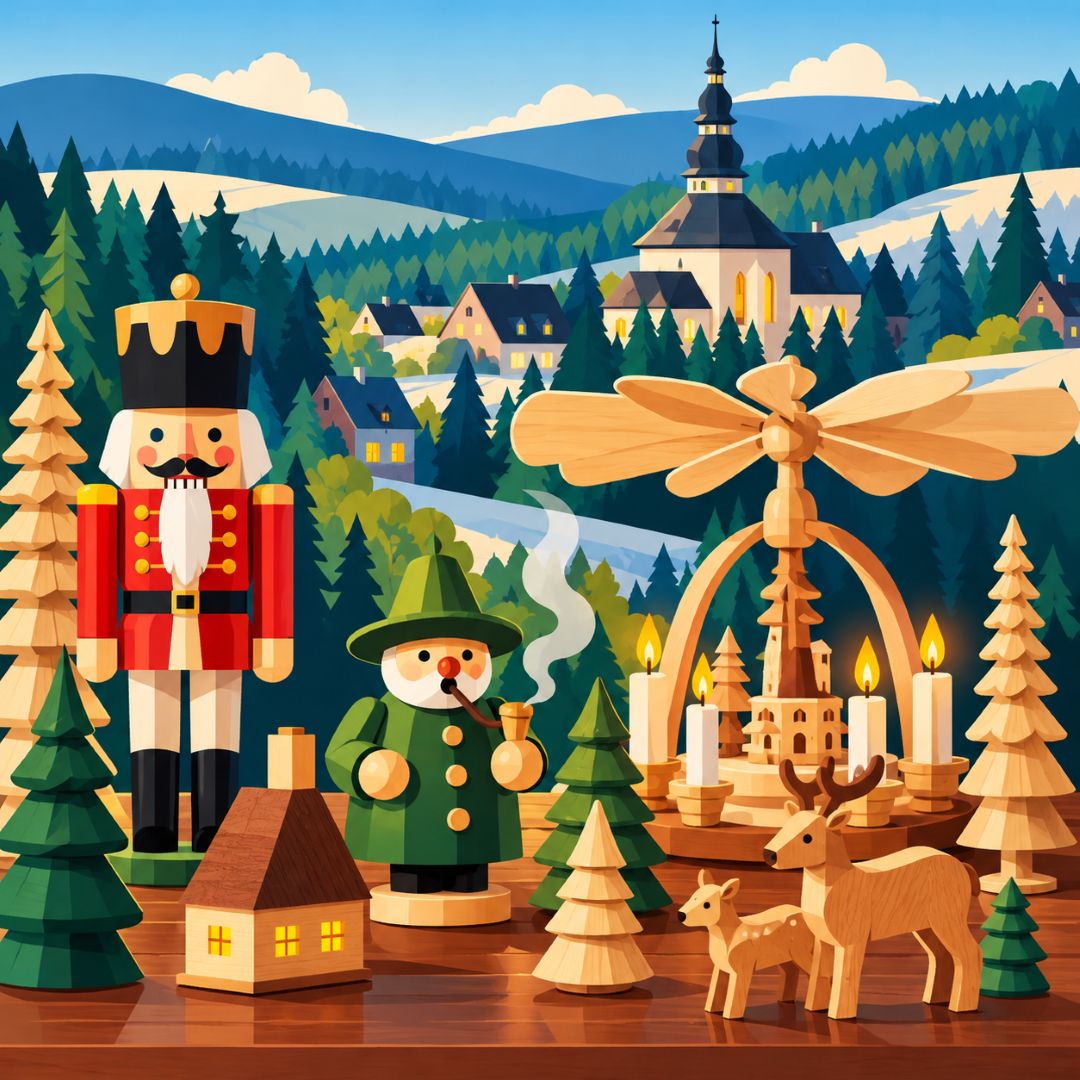
The Ore Mountains have a particularly strong Christmas tradition, and Seiffen has become one of its most recognizable centers. Wooden Christmas arches, angels, miners, pyramids, ornaments, candle holders, nutcrackers, and Raeuchermaenner – traditional wooden smoking figures – are closely associated with the region.
During Advent, Seiffen can look almost like a living Christmas workshop. But the craftsmanship itself is not limited to December.
That is an important distinction. These are not simply seasonal decorations made for a few weeks each year. Woodworking remains part of Seiffen’s identity throughout the year.
Nutcrackers, Smokers, Angels, and More
Some of the most recognizable Erzgebirge figures are the wooden nutcrackers and smoking figures.
Nutcrackers are often dressed as soldiers, kings, miners, or other traditional characters. Their exaggerated faces and colorful clothing make them instantly recognizable.
Smoking figures have a completely different character. A small incense cone is placed inside the hollow figure, and the smoke rises through the mouth, giving the impression that the figure is actually smoking.
Angels, miners, shepherds, musicians, animals, village scenes, and miniature buildings add even more variety.
Many of these designs reflect the history and everyday life of the Ore Mountains. Mining, religion, family life, music, forests, and village traditions all appear in the region’s wooden art.
More Than Carving
It is tempting to describe everything from Seiffen simply as wood carving. But that does not really do the craftsmanship justice.
Turning, carving, painting, assembling, and other specialized techniques all play a role in Erzgebirge wood art. Some pieces are made from numerous individual components, each produced using a different step of the traditional process.
Ring turning is perhaps the most distinctive example because the technique itself is so closely connected with the Seiffen area.
That combination of techniques is one reason the finished figures can look so detailed despite their small size.
A Craft Passed Through Generations
One of the things I find most appealing about traditional German craftsmanship is the connection between the object and the people who made it.
In Seiffen, woodworking developed from an economic necessity into a cultural tradition. Skills that once helped families make a living gradually became part of the identity of an entire region.
That history is still visible in the workshops, museums, shops, and wooden figures found throughout Seiffen.
The craftsmanship may have changed with modern tools and markets, but the basic idea remains remarkably familiar: take a piece of wood and turn it into something that makes people smile.
Seiffen Today
Modern Seiffen is still closely associated with wood art and toy making. The village has numerous shops offering traditional Erzgebirge wooden products, as well as museums and workshops where visitors can learn about the history of the craft.
The Seiffen Open Air Museum is particularly interesting because it preserves historic buildings and workshops from the Ore Mountains. Traditional techniques such as ring turning can be demonstrated in an authentic historical setting.
The Erzgebirge Toy Museum also documents the development of the region’s toy-making tradition and the many forms of wooden art that grew from it.
So Seiffen is not simply a place where you can buy wooden Christmas decorations. It is a place where you can see the history behind them.
Why Seiffen Wood Art Is So Special
For me, the appeal is not that these objects are large, expensive, or spectacular.
It is almost the opposite.
A small wooden angel, a tiny animal, a miniature miner, or a little village scene can represent an enormous amount of knowledge and handwork. The finished object may fit comfortably into your hand, while the tradition behind it reaches back through generations.
That gives these pieces a character that mass-produced decorations simply cannot reproduce in quite the same way.
A Little Piece of the Ore Mountains
You do not have to be a serious collector to appreciate Seiffen wood art.
Perhaps you like German Christmas traditions. Perhaps you collect nutcrackers or wooden ornaments. Perhaps you simply enjoy beautifully made objects with a story behind them.
In any of those cases, a piece of Erzgebirge wood art can be a small reminder of a very particular part of Germany.
At GermanBuy, you can find German collectibles and traditional items that bring some of that craftsmanship to collectors and enthusiasts outside Germany. Our German collectibles selection includes items connected with German traditions, culture, and craftsmanship.
Seiffen Is More Than a Christmas Village
Christmas may have made Seiffen famous internationally, but the story of this little village is much older and much broader.
It is a story about mining, forests, woodworking, trade, family traditions, ingenuity, and the ability of a community to turn an old craft into a lasting cultural identity.
And perhaps that is what makes Seiffen so fascinating.
When you look at one of its little wooden figures, you are not just looking at a decoration.
You are looking at a small piece of the Ore Mountains.
Further Reading
Kurort Seiffen – Official Tourism Information
Seiffen – History of Ring Turning
Erzgebirge Tourism – Traditional Wood Art
Erzgebirge Toy Museum Seiffen