Schnitzel with Asparagus and Hollandaise Sauce
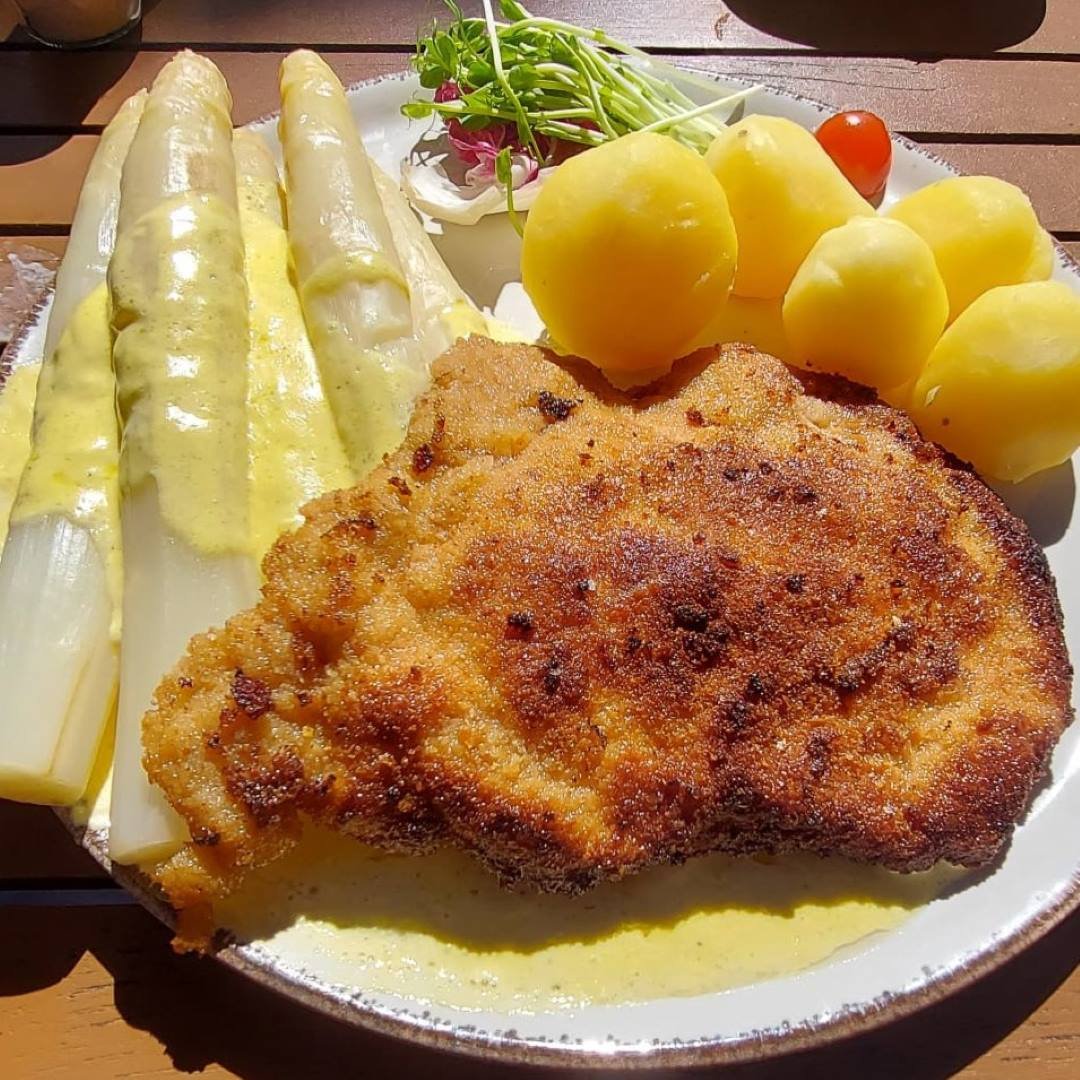
When spring arrives in Germany, asparagus season is one of the highlights of the culinary year. For a limited time, fresh white asparagus appears at farm stands, weekly markets, and grocery stores across the country. One of my favorite ways to think about this season is a plate of Schnitzel with white asparagus, Salzkartoffeln (boiled potatoes), and Hollandaise sauce.
German Asparagus Season
White asparagus, known in Germany as Spargel, has a special place in German spring cooking. Unlike green asparagus, the white stalks grow underground and farmers harvest them before sunlight reaches them. This keeps them pale and gives them their characteristic mild flavor.
The traditional German asparagus season generally begins around mid-April, although weather and growing conditions can move the start from one year to the next. Traditionally, the season ends on June 24, St. John’s Day (Johannistag).
That short season is part of what makes Spargel so special. During these weeks, asparagus stands appear near farms and along roads, markets offer fresh local harvests, and restaurants put seasonal asparagus dishes on their menus.
For a broader look at German spring cooking, including asparagus and wild garlic, see our article German Spring Food: Asparagus, Wild Garlic and More.
A Plate That Belongs at the Start of Spargel Season
When asparagus season begins, a good German restaurant often puts dishes like this on the menu. Schnitzel, fresh white asparagus, boiled potatoes, and Hollandaise bring together several ingredients that Germans traditionally associate with spring.
For me, the best place to experience that combination is often not a city restaurant but a Spargelhof with its own restaurant. These asparagus farms make the seasonal connection particularly clear: you can see where the asparagus comes from, enjoy it at its freshest, and eat a dish that belongs to the time of year rather than a year-round menu.
A visit to a Spargelhof with a restaurant can therefore turn a simple lunch into part of the asparagus season itself. If you are traveling through Germany during spring, it is worth looking for one in an asparagus-growing region.
Why Schnitzel and Asparagus Work So Well Together
The combination is simple but satisfying. A crisp, golden Schnitzel provides a savory contrast to the tender asparagus, while Hollandaise adds a rich, buttery sauce. Boiled potatoes complete the plate and provide a mild accompaniment that works especially well with the sauce.
The dish does not depend on complicated seasoning. Instead, each component brings something different to the plate: crisp breading, tender asparagus, creamy sauce, and soft potatoes.
What Is Schnitzel?
For readers unfamiliar with the German term, Schnitzel is a thin cutlet of meat that is commonly breaded and fried. Pork and veal are both widely used in German cooking.
Wiener Schnitzel has a more specific meaning. Traditionally, it consists of a breaded and fried veal cutlet and is associated with Viennese cuisine. Pork Schnitzel is extremely common in Germany, but it is not technically Wiener Schnitzel.
For this springtime dish, either pork or veal works well. The important part is to use thin, evenly prepared cutlets so the breading becomes crisp while the meat remains tender.
Preparing Schnitzel with Asparagus and Hollandaise
This version is straightforward enough for a home-cooked spring meal. You can bread the Schnitzel yourself with the classic flour, egg, and breadcrumb method, or choose a convenient German breading mix such as Knorr Fix Crunchy Wiener Schnitzel.
Ingredients
- 4 thin pork or veal Schnitzels
- 500–750 g (about 1.1–1.7 lb) fresh white asparagus
- 450 g (about 1 lb) small potatoes
- Salt and freshly ground black pepper
- All-purpose flour for dredging
- 2 eggs, beaten
- Breadcrumbs for coating
- Butter, vegetable oil, or a combination of both for frying
- Hollandaise sauce, homemade or prepared
- Optional: fresh parsley or chives for serving
Instructions
-
Prepare the asparagus.
Peel the white asparagus from just below the tip toward the bottom and trim off the woody ends. Bring a large pot of lightly salted water to a gentle boil. Add a small amount of sugar if you like. Cook the asparagus for about 8 minutes, depending on the thickness of the stalks. The spears should be tender but still hold their shape. -
Cook the potatoes.
Place the potatoes in a pot of salted water and simmer until tender when pierced with a fork. Drain and keep them warm. You can peel them before cooking or leave the skins on, depending on the potatoes you use and your preference. -
Prepare the Schnitzel.
Place each cutlet between two sheets of plastic wrap or parchment paper and gently pound it until evenly thin. Season both sides with salt and pepper. -
Bread the meat.
Set out three shallow dishes for the flour, beaten eggs, and breadcrumbs. Coat each Schnitzel first in flour, then in the egg, and finally in the breadcrumbs. Avoid pressing the breadcrumbs too firmly onto the meat. -
Fry the Schnitzel.
Heat enough butter, oil, or a combination of both in a large skillet to generously coat the bottom. Fry the Schnitzel over medium-high heat until golden brown on both sides and cooked through. Work in batches if necessary so the pan does not become overcrowded. -
Prepare the Hollandaise.
Make the Hollandaise according to your preferred recipe, or prepare Knorr Hollandaise Sauce Classic Mix according to the package directions. Keep the sauce warm, but do not let it boil. -
Assemble the plate.
Arrange the asparagus and boiled potatoes on each plate. Add the Schnitzel and spoon the warm Hollandaise over the asparagus. Finish with a little chopped parsley or chives if desired.
A Convenient Shortcut for the Schnitzel
If you want a simpler preparation, Knorr Fix Crunchy Wiener Schnitzel offers a convenient alternative to preparing the breading from scratch. The German mix is designed for three Schnitzels and combines the seasoning and coating in one preparation.
That can be useful when you are already preparing asparagus, potatoes, and Hollandaise at the same time. Instead of setting up several ingredients for the breading, you can keep the Schnitzel preparation more straightforward and focus on getting the entire meal onto the table at the same time.
How Germans Serve Asparagus
White asparagus often takes center stage rather than serving as just another vegetable on the plate. Classic German asparagus meals therefore tend to keep the other components relatively simple.
Boiled potatoes are a natural companion because they complement the asparagus without competing with it. Hollandaise brings richness, while the Schnitzel contributes the crisp texture and savory flavor that turns the combination into a substantial main course.
Another familiar way to serve German asparagus pairs it with ham instead of Schnitzel. Some people prefer melted butter rather than Hollandaise. The basic idea remains the same: let the fresh asparagus take the lead and use a few familiar ingredients to complement it.
White Asparagus and Green Asparagus
White and green asparagus come from the same plant, Asparagus officinalis, but growers cultivate them differently. White asparagus stays underground so that the stalks remain protected from sunlight. Green asparagus grows above ground and develops its characteristic color through exposure to light.
The difference is noticeable on the plate. White asparagus has a delicate, slightly sweet flavor and a tender texture when properly cooked. Green asparagus generally has a more pronounced vegetal flavor and a firmer texture.
For this particular German-style dish, white asparagus is the traditional choice.
Why Spargel Season Feels Different in Germany
There is something distinctly seasonal about eating Spargel in Germany. Once the first local asparagus reaches the markets, restaurants start featuring special asparagus dishes, farm stands advertise their harvest, and households return to recipes that appear for only part of the year.
The limited season gives asparagus a status that an ordinary year-round vegetable does not have. For a few weeks, it becomes a recurring feature of German menus and home cooking. Then the season ends and the roadside asparagus stands disappear again.
That is also why I think a visit to a Spargelhof with a restaurant can be such a good way to experience this tradition. You are not simply ordering an asparagus dish; you are eating something closely connected to the place, the harvest, and the season.
A German Spring Meal Worth Waiting For
Schnitzel with white asparagus, boiled potatoes, and Hollandaise brings several familiar elements of German cooking together on one plate. The Schnitzel supplies the crisp texture, the asparagus brings the seasonal character, and the potatoes and sauce tie everything together.
It is not a complicated meal, and that is part of its appeal. German spring cooking often lets seasonal ingredients do most of the work. During Spargelzeit, fresh white asparagus provides more than enough reason to return to a classic combination like this one.
If you make the dish outside the German asparagus season, fresh white asparagus from another growing region can still work well. But when you have the chance to visit Germany during spring, I would put a good Spargelhof with a restaurant high on the list. A plate of fresh Spargel with Schnitzel, potatoes, and Hollandaise is one of those meals that makes sense precisely because of where and when you eat it.