White Gold – Porcelain in the GDR

White Gold: Porcelain in the GDR
When people think about porcelain from Germany, Meissen is often the first name that comes to mind. But German porcelain has always been much broader than the famous manufactory in Saxony. In the German Democratic Republic (GDR), porcelain was not simply something reserved for special occasions. It was part of everyday life — in private homes, restaurants, hotels, canteens, railway stations, and public institutions.
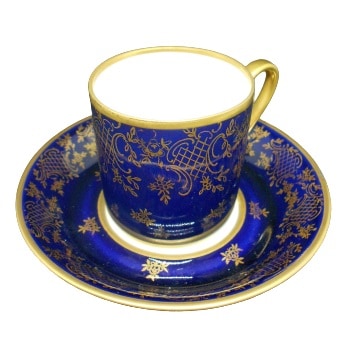
I have always found some of the smaller pieces of GDR porcelain especially appealing. There is something about the combination of white porcelain, deep cobalt blue, and gold decoration that immediately catches my eye. One example currently available at GermanBuy is this small Reichenbach mocha cup and saucer. I simply think it is a beautiful piece.
Why Porcelain Was Once Called “White Gold”
Porcelain was once one of the most desirable luxury materials in Europe. European courts were fascinated by the fine white ceramic imported from East Asia, while European manufacturers initially struggled to reproduce true hard-paste porcelain themselves.
A major breakthrough came in Saxony at the beginning of the 18th century. Johann Friedrich Böttger, working with Ehrenfried Walther von Tschirnhaus under the patronage of Augustus the Strong, succeeded in developing European hard-paste porcelain around 1708 and 1709. The Meissen manufactory was established in 1710.
Meissen went on to become one of the most influential names in European porcelain. But the development of German porcelain did not stop there. Over the following centuries, porcelain production spread to many parts of what is now Germany, with Thuringia becoming one of the most important porcelain regions.
Porcelain in the German Democratic Republic
After the Second World War, porcelain production in the Soviet occupation zone and later in the GDR continued under a state-controlled economic system. Many factories became Volkseigene Betriebe, commonly abbreviated as VEB.
Porcelain had a surprisingly broad role in East German life. Factories produced cups, saucers, plates, bowls, coffee and tea services, catering tableware, decorative pieces, commemorative porcelain, and specially designed items for institutions and organizations.
The result was a very diverse porcelain landscape. Some pieces were deliberately simple and functional. Others featured colorful floral or animal decoration, strong geometric forms, cobalt blue, gold details, or more elaborate designs.
The DDR Museum describes four major Thuringian producers as the “big four” of GDR porcelain: Kahla, Ilmenau, Weimar, and Lichte. Over time, a number of smaller, previously independent factories were incorporated into these larger operations. Their products became an important part of the visual and material culture of everyday life in East Germany.
Kahla: Everyday Porcelain in East Germany
If there is one name that immediately comes to mind when thinking about everyday porcelain in the GDR, Kahla is certainly among them.
Porcelain production in Kahla began in 1844, long before the GDR existed. The industry became the dominant economic activity of the town, and the porcelain factory continued operating after the Second World War under the East German state-owned system.
During the GDR period, Kahla developed into a major center of the East German fine-ceramics industry. The later VEB Kombinat Feinkeramik Kahla brought together a number of operations within the industry and became an important production center.
Kahla porcelain was made in large quantities for everyday use. Cups, saucers, plates, coffee services, and other tableware could be found in countless East German households. That is one reason the name Kahla still feels particularly familiar to people who grew up in the former GDR.
Not all Kahla porcelain was plain, however. Alongside functional household services, the factory produced more decorative designs. One particularly interesting example is the use of mother-of-pearl decoration, which became a characteristic feature of some GDR-era Kahla tableware.
The DDR Museum includes a Kahla coffee service among its examples of GDR porcelain, illustrating how everyday tableware could combine practical forms with distinctive decoration.
Ilmenau and Graf von Henneberg
Another important center was Ilmenau in Thuringia. The town has a long porcelain tradition, and during the GDR period the name Graf von Henneberg became closely associated with Ilmenau porcelain.
The VEB Porzellanwerk Graf von Henneberg produced household and institutional tableware, including coffee and tea services. Its products ranged from everyday porcelain to more elaborately decorated pieces.
One particularly interesting example is the Halka service. Its basic form was designed by porcelain designer Werner Winkler, who received a Gold Medal for “Good Design” for the form at the Leipzig Fair in 1962. The VEB Porzellanwerk Graf von Henneberg later used the form with blue decoration and a gold rim.
Examples like this show that GDR porcelain was not simply about producing large quantities of basic tableware. Industrial design also played an important role, and some forms were deliberately created to give everyday objects a contemporary appearance.
Weimar Porcelain from Blankenhain
The name Weimar Porzellan is another important part of the Thuringian porcelain story. Although associated with Weimar, the production site was located in Blankenhain, near Weimar.
The factory had a long history before the GDR period and continued as a state-owned enterprise after nationalization. During the GDR era, VEB Weimarer Porzellanfabrik produced both household porcelain and decorative pieces.
Weimar porcelain is particularly interesting for collectors because cobalt decoration became an important part of its visual character. Surviving GDR pieces can be found with markings referring to Weimar Porzellan and cobalt decoration, sometimes combined with the words “Made in GDR.”
As with Kahla and Henneberg, the range extended well beyond one particular style. There was functional tableware for everyday use as well as more decorative porcelain associated with special occasions and institutions.
Lichte and Decorative Porcelain
The fourth of the major Thuringian centers was Lichte.
The porcelain tradition in Lichte dates back to the 19th century. During the GDR period, the factory operated as the VEB Zierporzellanwerk Lichte. The name itself reflects the factory’s particular focus on decorative porcelain.
Lichte produced a variety of ornamental and figurative pieces as well as other porcelain goods. This makes it especially interesting when looking at GDR porcelain beyond the familiar coffee cups and dinner plates.
The decorative side of Lichte porcelain also illustrates an important point about the GDR industry as a whole: East German porcelain was not defined by one uniform aesthetic. Functional tableware, colorful decorated services, commemorative pieces, figurines, and more elaborate decorative objects all existed alongside one another.
Colditz and Porcelain for Everyday Use
Colditz is another name worth knowing when looking at porcelain from the GDR.
The VEB Vereinigte Porzellanwerke Colditz became particularly important for institutional and catering porcelain. One of its best-known products was the Rationell service, developed in 1969 and 1970 by product designers Margarete Jahn and Erich Müller.
The design received a Gold Medal for “Good Design” at the Leipzig Fair in 1970. During the early 1970s, the service was used not only by Mitropa, the East German railway and catering organization, but also in restaurants, company and school canteens, hospitals, and hotels.
That gives Colditz porcelain a slightly different place in the story. It was not necessarily porcelain for the private dining room. Much of it was designed to withstand the demands of everyday institutional and commercial use.
There are also more decorative Colditz pieces. For example, the cobalt-blue bowl currently offered by GermanBuy shows how the manufacturer could combine a deep blue surface with decorative gold details.
It is a good reminder that GDR porcelain cannot always be neatly divided into “plain everyday ware” and “collectible decorative porcelain.” There was considerable variety within the production of individual factories as well.
More Than Four Factories
Kahla, Ilmenau, Weimar, and Lichte are useful names to know, but they do not represent the entire porcelain industry of the GDR.
There were numerous other factories and production sites throughout East Germany. Meissen continued operating as a state-owned enterprise, while manufacturers such as Colditz and Reichenbach contributed their own products and traditions.
The industry was also reorganized several times during the GDR period. Factories were combined, incorporated into larger state-owned structures, and assigned different production responsibilities.
This is one reason why identifying GDR porcelain can sometimes be fascinating. A piece may carry the name of a familiar factory while also reflecting a particular period, production group, form, pattern, or institutional purpose.
Porcelain for Ordinary Life
Perhaps the most interesting thing about GDR porcelain is that so much of it was never intended to become collectible.
It was made to be used.
People drank coffee from Kahla and Henneberg cups, served meals on porcelain plates, used sugar bowls and creamers, and brought out nicer services for family gatherings. Porcelain was also part of restaurants, hotels, railway catering, company cafeterias, schools, and hospitals.
That everyday role is part of what makes these pieces interesting today. A simple coffee cup can tell us something about the design, manufacturing, materials, and habits of the period in which it was made.
It also explains why GDR porcelain can still feel familiar. For many people who grew up in East Germany, these were not museum objects. They were simply part of the household.
The Appeal of Cobalt Blue
For me, the color is probably the first thing that makes certain pieces stand out.
Cobalt blue has a particularly deep and distinctive appearance on porcelain. Against white porcelain, it can look remarkably crisp, while gold decoration adds another layer without necessarily making the design feel excessive.
Cobalt compounds have been used as ceramic pigments for centuries. Cobalt-based blue pigments are particularly useful for porcelain decoration because they can withstand the high temperatures involved in firing.
Cobalt decoration was not exclusive to one GDR manufacturer. It appears on porcelain from different factories and periods, which is another reason why the factory mark, decoration, form, and other details should be considered together when identifying a piece.
I simply like the way cobalt blue looks. On a small porcelain cup, especially when combined with gold, the color has a presence that is difficult to ignore.
Reichenbach Porcelain
That brings me to Reichenbach, another important name in the Thuringian porcelain tradition.
The porcelain history of Reichenbach goes back to 1830. In 1900, nine porcelain painters from the area joined together to establish a porcelain factory at the site that became the foundation for the later manufactory.
During the GDR period, Reichenbach porcelain was produced within the East German state-owned industrial system. Surviving pieces from this period provide another example of the range of designs and decorative techniques found in East German porcelain.
Some Reichenbach pieces from the period are marked with terms such as “Fine China,” “Made in GDR,” and “Echt Kobalt.”
What “Echt Kobalt” Means
The words “Echt Kobalt” are particularly interesting when looking at vintage German porcelain.
In this context, the marking refers to the cobalt used for the blue decoration. It does not mean that the porcelain itself is made from cobalt, and the marking alone does not establish that a particular piece is rare or valuable.
That distinction matters when collecting vintage porcelain. A manufacturer’s mark, a particular color, or a decorative technique can help identify a piece, but collectors normally consider several factors together, including the factory, production period, pattern, condition, completeness, and provenance.
I would therefore not describe every cobalt-blue Reichenbach piece as rare or valuable. Sometimes the reason to own something is much simpler: you like it.
A Small Reichenbach Mocha Cup with a Lot of Character
The small Reichenbach mocha cup and saucer that I mentioned at the beginning of this article is a good example of what I find so appealing about GDR porcelain. It brings together several things that make these pieces interesting to me: the Thuringian porcelain tradition, the history of the GDR, the distinctive cobalt-blue decoration, and the smaller scale of a traditional mocha cup.
The piece is marked Reichenbach R Fine China, Made in GDR, and Echt Kobalt. Those markings place the piece within the wider history of East German porcelain and make it possible to connect this little cup with a specific manufacturer and period.
What I particularly like is the combination of the deep cobalt blue with the gold decoration. On a small cup and saucer, the colors have a strong visual presence without making the design feel overwhelming.
The Reichenbach mocha cup and saucer at GermanBuy is one of those pieces that I would not necessarily choose because it is large, spectacular, or unusual. I like it because it is a small, well-decorated object that has clearly lived a life before becoming part of a collection.
For me, that is exactly where the appeal of vintage porcelain lies. You can look at a small cup and see much more than just a piece of tableware.
Why I Like These Little Cups
I think objects like this are a good reminder that collecting does not always have to be about rarity or monetary value.
Sometimes you see something and simply like it.
That is how I feel about these cobalt-blue mocha cups. The deep blue, the gold decoration, the small proportions, and the history behind the piece all come together in a way that I find particularly attractive.
It is also interesting to think about the journey of a small cup like this. It was manufactured decades ago in East Germany, used at some point in someone’s everyday life, and has now survived long enough to become a vintage collectible.
That gives an otherwise ordinary piece of porcelain a little more character.
How to Look at GDR Porcelain
If you are interested in collecting porcelain from the GDR, the mark on the underside is often a good place to start.
Names such as Kahla, Graf von Henneberg, Weimar Porzellan, Lichte, Colditz, and Reichenbach can provide an important first clue about a piece’s origin.
Markings such as “Made in GDR” can help place an item within the period, while additional words such as “Fine China” or “Echt Kobalt” can provide further information about the piece and its decoration.
But identifying vintage porcelain is rarely as simple as reading one mark. The form, decoration, factory history, production period, condition, and sometimes even the intended use all add pieces to the puzzle.
White Gold from East Germany
The story of German porcelain did not end with Meissen, and it certainly did not end with the division of Germany after the Second World War.
Factories such as Kahla, Henneberg in Ilmenau, Weimar in Blankenhain, Lichte, Colditz, and Reichenbach continued a much older German and Thuringian porcelain tradition under the very different political and economic conditions of the GDR.
Some of their products were plain household tableware. Others were colorful, highly decorated, commemorative, or designed for institutions. Together, they form a fascinating record of everyday life and industrial design in East Germany.
For me, the small cobalt-blue Reichenbach mocha cup is a particularly nice example. It is not an enormous historical object, but it does not need to be. Sometimes a beautifully decorated cup and saucer can tell a surprisingly interesting story.
German GDR Porcelain at GermanBuy
If you enjoy vintage German porcelain, take a look at the GermanBuy porcelain collection. The selection includes vintage and collectible porcelain pieces from Germany, including individual pieces with the marks and characteristics that make vintage porcelain interesting to collectors.
And if you happen to like cobalt-blue porcelain as much as I do, pay attention to the smaller pieces. They may be modest in size, but they can have plenty of character — and sometimes a surprisingly interesting history behind them.
Further Reading:
MEISSEN – History of the Manufactory
Porzellanmanufaktur Reichenbach – History of the Manufactory
DDR Museum – White Gold: Porcelain in the GDR
City of Kahla – Historical overview of the porcelain industry in Kahla