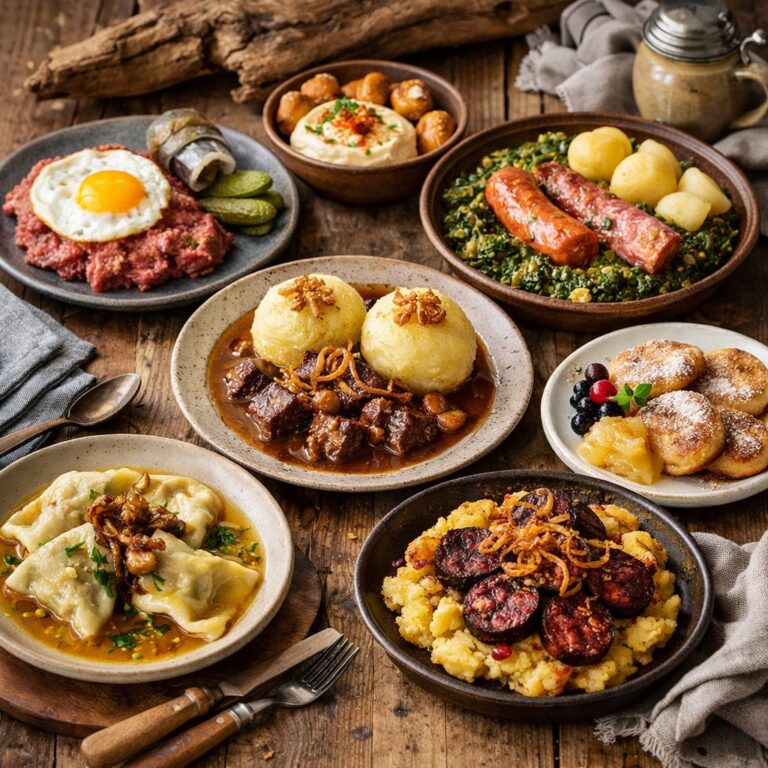
Culinary Specialties of German Federal States

Exploring Germany’s Federal States and Their Culinary Specialties
Germany is not one single culinary region. Its 16 federal states have developed their own food traditions, influenced by local agriculture, climate, geography, history, and neighboring countries.
Some specialties are closely associated with a particular city or region, while others are enjoyed far beyond the state where they originated. From Swabian Maultaschen and Bavarian Weisswurst to North German fish sandwiches and Thuringian Rostbratwurst, regional food is an important part of everyday life and German culture.
This overview looks at one well-known specialty from each federal state. It is not intended to name the only or even the single most important dish from each state. German regional cuisine is far too varied for that.
Baden-Wuerttemberg: Maultaschen
Maultaschen are one of the best-known specialties of Baden-Wuerttemberg, particularly associated with Swabian cuisine. They are large pieces of filled pasta, often compared with ravioli, traditionally prepared with a filling that can include meat, spinach, onions, and breadcrumbs.
Maultaschen can be served in broth, browned in a pan, or accompanied by onions and other ingredients. There is also a well-known story that the filling was used to conceal meat during Lent, although this is generally treated as a legend rather than a proven historical origin.
Bavaria: Weisswurst
Bavarian Weisswurst, or white sausage, is one of Germany’s most recognizable regional specialties. The sausage is traditionally made from finely minced meat and seasoned with ingredients such as parsley, lemon, and spices.
Weisswurst is traditionally served warm with pretzels and sweet Bavarian mustard. The custom of eating Weisswurst before noon is well known, although it is a tradition rather than a food-safety rule. You can also find it served later in the day, particularly outside Bavaria.
GermanBuy also offers Bavarian Weisswurst for those who want to try this regional specialty at home.
Berlin: Currywurst
Currywurst is one of Berlin’s most famous contributions to German street food. The dish is generally made with a cooked pork sausage that is sliced and served with a tomato-based curry sauce, often accompanied by fries or a bread roll.
Berlin’s currywurst tradition is closely associated with Herta Heuwer, who is widely credited with creating the dish in Berlin in 1949. The exact history of currywurst has been the subject of debate, but its importance to Berlin’s food culture is not.
For a convenient way to prepare a currywurst-style sauce at home, GermanBuy also carries Maggi Currywurst seasoning and Knorr Currywurst sauce mix.
Brandenburg: Spreewald Gherkins
In Brandenburg, one of the most distinctive regional specialties comes from the Spreewald: Spreewald gherkins, known in German as Spreewaelder Gurken.
Cucumbers have been cultivated and preserved in the Spreewald for generations. The regional product is protected under European geographical indication rules, and several traditional varieties and preparations can be found in the region.
Spreewald gherkins are commonly enjoyed as a snack, with cold meals, or alongside hearty German dishes. They are a good example of how local agriculture can become part of a region’s culinary identity.
Bremen: Bremer Klaben
Bremer Klaben is a traditional fruit bread from Bremen, particularly associated with the Christmas season. It is made from a rich yeast dough containing ingredients such as dried fruit and is related to the wider tradition of German festive fruit breads.
The loaf is traditionally prepared in a substantial, elongated form and is particularly popular during the winter and Christmas period. It is one of the specialties that reflects Bremen’s long trading history and its connection with ingredients brought from abroad.
Hamburg: Fischbroetchen
With its long maritime history and major port, Hamburg has a strong connection to fish and seafood. One of the simplest and most recognizable examples is the Fischbroetchen, or fish sandwich.
A Fischbroetchen can contain different types of fish, including herring, matjes, Bismarck herring, or fried fish. Depending on the preparation, it may be served with onions, pickles, lettuce, or remoulade sauce.
It is particularly associated with northern Germany and the coastal regions, where fish sandwiches remain a popular casual meal.
Hesse: Handkaese mit Musik
Handkaese mit Musik is a traditional Hessian specialty made with Handkaese, a small sour-milk cheese. The cheese is typically served with a marinade containing vinegar, oil, onions, and caraway.
The unusual name translates roughly as “hand cheese with music.” The “music” is a humorous reference to the digestive effects sometimes associated with the raw onions.
Handkaese mit Musik is closely connected with the food culture of Hesse and is often enjoyed with bread and a glass of Apfelwein, the regional apple wine.
Lower Saxony: Gruenkohl und Pinkel
Gruenkohl und Pinkel is a classic winter dish in Lower Saxony and parts of northern Germany. It combines cooked kale with Pinkel, a traditional type of sausage, and is often served with potatoes and other smoked or cured meats.
The dish is closely associated with the Grünkohlfahrt, or kale tour. Groups traditionally go on a winter walk, often with stops for food and drinks, before sitting down together for a hearty kale meal.
The tradition remains particularly popular during the colder months. Germany Travel also highlights kale with Pinkel as one of the characteristic dishes of northern Germany.
Mecklenburg-Vorpommern: Rote Gruetze
Rote Gruetze is a traditional northern German dessert made from red berries or other red fruits. Depending on the recipe, it can contain raspberries, currants, cherries, strawberries, or a combination of different fruits.
The fruit mixture is thickened and traditionally served cold with vanilla sauce, milk, cream, or ice cream. Rote Gruetze is not limited to Mecklenburg-Vorpommern, however. It is a specialty found across northern Germany and parts of Scandinavia.
North Rhine-Westphalia: Rheinischer Sauerbraten
Rheinischer Sauerbraten is a well-known specialty of the Rhineland in North Rhine-Westphalia. It is a marinated pot roast traditionally prepared by soaking the meat in a seasoned marinade before slow cooking.
Today, beef is commonly used, although horse meat was historically used in some versions of Sauerbraten. The finished roast is typically served with a rich sauce and side dishes such as red cabbage and potato dumplings.
For a convenient preparation at home, GermanBuy also offers Knorr Sauerbraten seasoning mix.
Rhineland-Palatinate: Saumagen
Saumagen is one of the best-known dishes associated with the Palatinate region of Rhineland-Palatinate. Despite its name, which literally refers to a pig’s stomach, the stomach is traditionally used as a casing rather than simply being served as the main ingredient.
The filling commonly contains pork, potatoes, and spices. Saumagen is traditionally sliced after cooking and can be served with sauerkraut, potatoes, or other hearty side dishes.
The dish became particularly well known outside the region through former German Chancellor Helmut Kohl, who was a strong admirer of Palatinate cuisine and famously served Saumagen to political guests.
Saarland: Dibbelabbes
Dibbelabbes is a traditional Saarland potato dish made primarily from grated potatoes, onions, leeks, and often bacon or other pork ingredients.
The mixture is cooked in a pan until the outside becomes crisp while the inside remains soft. Dibbelabbes is a good example of the hearty, uncomplicated cooking found in many traditional regional German kitchens.
Saxony: Quarkkeulchen
Saxon Quarkkeulchen are small pancakes made with quark, potatoes, flour, eggs, and sugar. Unlike a typical American pancake, the mixture combines dairy and cooked potatoes to create a distinctive texture.
Quarkkeulchen are usually served sweet, often with applesauce, cinnamon sugar, fruit, or another sweet topping. They are a familiar specialty of Saxon home cooking.
Saxony-Anhalt: Halloren Chocolate
Saxony-Anhalt has a long confectionery tradition, particularly in the city of Halle. Halloren Kugeln are among the best-known sweets associated with the region.
The chocolates are produced by Halloren, a historic confectionery company based in Halle. The Halloren Chocolate Factory traces its history back to 1804, making it one of Germany’s oldest chocolate-making companies.
Halloren Kugeln are known for their distinctive round shape and creamy filling covered with chocolate. They have become a recognizable specialty of Halle and Saxony-Anhalt.
Schleswig-Holstein: Fischbroetchen
Fischbroetchen is also strongly associated with Schleswig-Holstein and the North Sea and Baltic Sea coast. The classic fish roll can contain herring, matjes, fried fish, or seafood such as shrimp, depending on the location.
Simple ingredients such as onions, pickles, lettuce, and remoulade are often added. For many visitors, eating a Fischbroetchen near the water is part of the experience of visiting northern Germany.
Thuringia: Thueringer Rostbratwurst
Thueringer Rostbratwurst is one of Germany’s best-known regional sausages. The specialty has a long documented history in Thuringia and is traditionally made from pork with a characteristic blend of herbs and spices.
The sausage is typically grilled over charcoal or another suitable heat source and served hot, often in a bread roll with mustard. It is a familiar sight at markets, festivals, outdoor events, and traditional restaurants throughout Thuringia.
Germany Travel describes the Thuringian Rostbratwurst as representing around 600 years of culinary heritage, reflecting how deeply the sausage is connected with the region.
Why German Regional Cuisine Is So Diverse
The food traditions of Germany’s federal states show just how varied German cuisine can be. Geography plays an obvious role: northern coastal regions have strong fish traditions, while southern regions are known for dishes based on meat, pasta, dumplings, and dairy products.
History also matters. Germany’s regional cuisines have been influenced by neighboring countries and by centuries of trade, migration, and changing political borders. Baden-Wuerttemberg, for example, reflects influences from France and Switzerland, while northern cuisine developed alongside the North Sea and Baltic Sea trading regions.
Even within a single federal state, local specialties can differ considerably. A dish described as “typical” for a state is therefore best understood as a well-known regional example rather than the only food that defines the area.
A Taste of Germany, State by State
From Maultaschen in Baden-Wuerttemberg to Thueringer Rostbratwurst in Thuringia, Germany’s regional specialties tell a story about the country’s geography and history. Some dishes are everyday food, others belong to particular seasons or celebrations, and many have crossed state borders over time.
This is what makes German cuisine so interesting: there is no single menu that represents the whole country. A culinary journey through Germany is really a journey through many different regional food traditions.
Germany’s official tourism organization also presents German cuisine through its regional specialties, recipes, and the culinary traditions of all 16 federal states. Germany Travel’s overview of recipes from Germany is a useful starting point for anyone who wants to explore further.