Halloween in Germany: German Traditions and Customs
What Americans Should Know About German Halloween Traditions
If you are used to Halloween in the United States, Halloween in Germany may look familiar at first. You will see carved pumpkins, children in costumes, spooky decorations, Halloween parties, and plenty of candy. However, Germany has developed its own way of celebrating the holiday, and the experience can differ considerably from a typical American Halloween.
Halloween is a relatively recent addition to Germany’s calendar of popular celebrations. Unlike Christmas, Easter, or many long-established regional festivals, Halloween does not have centuries of continuous tradition in Germany. Modern Halloween gained popularity during the late 20th century, particularly during the 1990s, as American popular culture, media, and commercial influences brought the celebration to a wider German audience.
That combination makes Halloween in Germany particularly interesting for Americans. Many familiar customs remain, but the cultural setting around them is distinctly German.
Do Germans Celebrate Halloween?
Yes, many Germans celebrate Halloween, but participation varies considerably. Halloween is not a nationwide public holiday, and not every family or community takes part.
Children may dress up and visit houses for candy, while teenagers and adults often attend Halloween parties, clubs, or other themed events. During October, supermarkets, retailers, bakeries, and entertainment venues also offer Halloween-related products and activities.
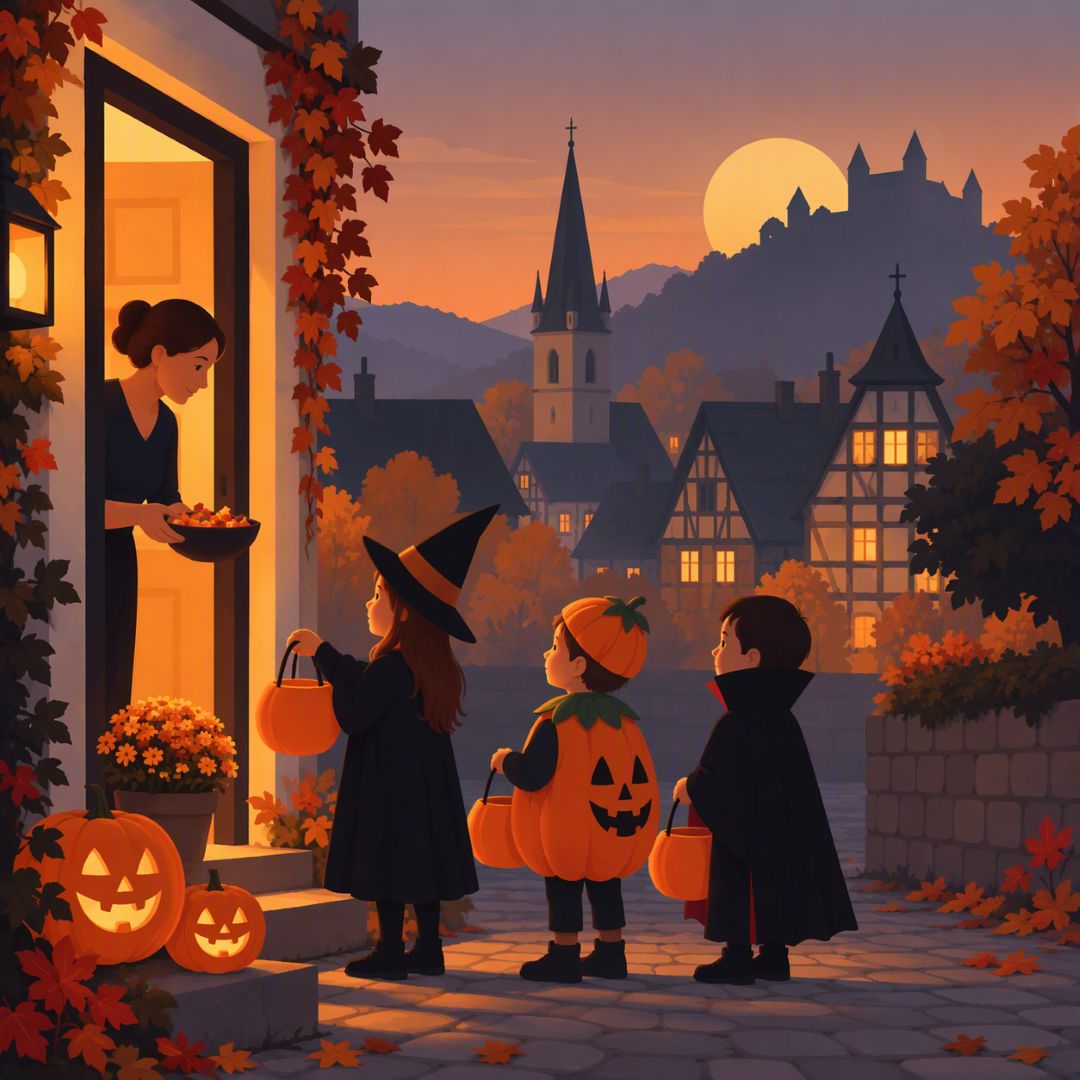
The biggest difference for American visitors may be the neighborhood experience. In the United States, many communities have a well-established tradition of children going from house to house on Halloween night. In Germany, the practice depends much more on the local area. Some neighborhoods welcome groups of costumed children, while others see very little Halloween activity.
So if you spend October 31 in Germany, do not assume that every household will have a large bowl of candy waiting at the door.
What to Expect on Halloween in Germany
If you are an American visiting Germany on October 31, do not expect every neighborhood to look like a typical American Halloween scene. Some streets may have groups of costumed children going from house to house, while the next neighborhood may remain completely quiet.
That difference can be surprising if you are used to decorated houses, pumpkins on front steps, and children carrying candy bags throughout the evening. In Germany, Halloween participation depends much more on the individual neighborhood and family.
If you want to experience trick-or-treating, it is worth checking with local friends, neighbors, or your accommodation before heading out. A neighborhood with many families and younger children is more likely to have participating households than a quiet residential area with few children.
And if nobody answers the door, it does not necessarily mean that people are ignoring Halloween. They may simply not participate.
When Is Halloween in Germany?
Halloween takes place on October 31, just as it does in the United States. The name comes from All Hallows’ Eve, meaning the evening before All Saints’ Day.
The date has another important meaning in Germany because October 31 is also Reformation Day, or Reformationstag. The day commemorates the Protestant Reformation and Martin Luther’s role in its history.
Reformation Day is a statutory public holiday in Brandenburg, Bremen, Hamburg, Mecklenburg-Western Pomerania, Lower Saxony, Saxony, Saxony-Anhalt, Schleswig-Holstein, and Thuringia. It is not a nationwide public holiday, so the legal status of October 31 depends on where you are in Germany.
For that reason, October 31 can represent very different things to different people in Germany. Some people associate the date with the Reformation, while others see it primarily as Halloween.
Halloween and All Saints’ Day in Germany
Halloween also has a connection to November 1, All Saints’ Day, known in Germany as Allerheiligen.
All Saints’ Day is a Christian observance that honors all saints. It is a statutory public holiday in Baden-Württemberg, Bavaria, North Rhine-Westphalia, Rhineland-Palatinate, and Saarland.
Halloween and All Saints’ Day are not the same celebration. Modern Halloween focuses largely on costumes, candy, pumpkins, parties, and spooky entertainment. All Saints’ Day has a religious purpose and a different cultural role.
The history behind Halloween itself is more complex than the simple claim that it is an unchanged ancient Celtic festival. The modern celebration developed through several historical influences. Traditions from Ireland and Scotland, Christian observances connected with All Saints’ Day, and later developments in North America all played a role in the Halloween familiar today.
How Did Halloween Become Popular in Germany?
Halloween did not suddenly become an old German tradition. Instead, the modern celebration gained visibility in Germany during the late 20th century, particularly during the 1990s.
American movies and television, international popular culture, the presence of US military communities, commercial marketing, and the growing availability of Halloween products all helped introduce the celebration to a wider German audience.
German retailers soon recognized the commercial potential of another costume and candy season outside the traditional carnival period. Stores began offering Halloween costumes, decorations, pumpkins, themed sweets, and party supplies.
Over time, families, schools, clubs, restaurants, and entertainment venues adopted different elements of the celebration. As a result, Halloween established itself as a modern seasonal event without becoming an old nationwide German tradition.
Trick-or-Treating in Germany
Children going from door to door for candy is one of the most recognizable Halloween traditions in Germany today.
German children may call out “Süßes, sonst gibt’s Saures!” when they visit a house. The phrase roughly corresponds to the American “Trick or treat!” It means that the children want something sweet and jokingly threaten a small prank if they receive nothing.
You may also hear children say “Süßes oder Saures!” or recite a short Halloween rhyme before receiving their treats.
The custom resembles American trick-or-treating, but it does not have the same level of nationwide participation. In some German neighborhoods, children visit many homes on Halloween. In others, residents may not expect Halloween visitors at all.
This local variation is one of the clearest differences between Halloween in Germany and the familiar American experience.
Tips for Americans Experiencing Halloween in Germany
If you are used to American Halloween traditions, a few small differences can make the evening easier to understand.
- Do not assume every house participates. Halloween is not celebrated at every German home, so look for signs of participation before knocking.
- Bring a small bag for candy. Children who go trick-or-treating may collect a variety of German sweets rather than the same mix of candy commonly found in the United States.
- Expect local differences. Larger cities and family neighborhoods may have more Halloween activity than quieter areas.
- Do not confuse Halloween with Carnival. Both involve costumes, but Carnival has a much longer and deeper tradition in Germany.
- Look beyond October 31. St. Martin’s lantern processions on November 11 offer another distinctly German children’s tradition that is worth experiencing.
For an American visitor, the most interesting part may be the contrast. You can recognize many familiar Halloween customs while noticing that Germany does not treat the evening as a single nationwide event.
What Do German Children Wear for Halloween?
German Halloween costumes look very familiar to American visitors. Witches, vampires, ghosts, skeletons, zombies, monsters, and other spooky characters remain popular choices.
Germany already has another major costume tradition, however: carnival. Depending on the region, Germans call it Karneval, Fasching, or Fastnacht.
Carnival costumes can represent almost anything. Children and adults may dress as animals, fairy-tale characters, professions, fictional characters, celebrities, or humorous figures. Halloween has a different atmosphere and focuses much more strongly on ghosts, monsters, horror, and other spooky themes.
The two celebrations therefore share a love of costumes, but they serve different cultural purposes in Germany.
Carved Pumpkins and Jack-o’-Lanterns in Germany
Carved pumpkins have become a familiar sight during October in Germany. Families may hollow out pumpkins, cut faces into them, and place lights inside.
The Jack-o’-lantern tradition has a long history connected with Halloween customs from the British Isles. Irish traditions used vegetables such as turnips before pumpkins became especially popular in North America.
Today, pumpkins already have a strong connection with autumn in Germany. German supermarkets, farm shops, and farmers’ markets commonly sell pumpkins during the fall season, and pumpkin dishes are popular in German autumn cooking.
That makes the pumpkin a natural part of modern Halloween celebrations, even though the large carved Jack-o’-lantern tradition has a particularly strong association with North American Halloween.
Halloween Decorations in Germany
Halloween decorations have become increasingly visible in German homes, gardens, stores, and entertainment venues.
Common decorations include carved pumpkins, artificial cobwebs, skeletons, witches, ghosts, gravestones, lanterns, and other spooky designs. Some families decorate a doorway or window, while others create elaborate displays in their gardens.
The scale can differ from what Americans expect. Halloween decoration is not universal in Germany, and participation depends heavily on the family, neighborhood, and local community.
Halloween Parties in Germany
Halloween is not just a children’s celebration in Germany. Teenagers and adults also enjoy Halloween parties, particularly in larger cities.
Bars, clubs, amusement parks, historic locations, and other venues may host Halloween events. Costumes, themed decorations, horror attractions, music, food, and drinks often form part of these celebrations.
For adults, Halloween in Germany often means attending a themed event rather than going from house to house for candy.
Halloween in Germany vs. Halloween in the United States
German and American Halloween share many familiar elements, but their cultural context differs.
| Halloween in Germany | Halloween in the United States |
|---|---|
| A relatively recent addition to German popular culture | A long-established part of American popular culture |
| Trick-or-treating varies considerably by neighborhood | Trick-or-treating is widespread in many communities |
| October 31 is also Reformation Day in several German states | October 31 is primarily associated with Halloween |
| Carnival provides another major costume tradition | Halloween is one of the country’s best-known costume traditions |
| Halloween participation can vary significantly from one region to another | Halloween customs are generally more consistent nationwide |
The biggest difference is not necessarily the individual customs. It is the place Halloween occupies within the culture. Americans often grow up with Halloween as a familiar annual tradition, while Germans experience it alongside older regional celebrations and customs.
For an American visitor, the easiest way to think about the difference is this: the familiar Halloween customs are there, but the level of participation is less predictable. A German Halloween night can be lively, quiet, or somewhere in between depending on where you are.
One Cultural Surprise for American Visitors
One of the biggest surprises for Americans may be how quickly Halloween can disappear from view. A supermarket may have Halloween candy and decorations, a nearby club may advertise a large costume party, and yet an ordinary residential street may show almost no sign of the holiday.
That contrast is perfectly normal. Halloween has become part of modern German popular culture, but it has not replaced older regional traditions or become an equally important celebration everywhere.
You may therefore experience two very different sides of Germany on the same evening: a commercial Halloween event that feels surprisingly familiar, followed by a quiet neighborhood where October 31 feels like an ordinary night.
What About St. Martin’s Day?
Americans visiting Germany in early November may encounter another children’s tradition that initially looks surprisingly familiar.
St. Martin’s Day, or Martinstag, takes place on November 11. In many German communities, children take part in lantern processions. They carry handmade lanterns, walk through their neighborhoods, sing traditional songs, and sometimes receive treats.
The similarities with Halloween are easy to notice: children, evening walks, lights, songs, and sweets all play a role.
St. Martin’s Day, however, is not German Halloween. The tradition has its own Christian history and centers on Saint Martin of Tours and the story of Martin sharing his cloak with a poor man.
For anyone learning about German culture, this distinction is important. Lantern processions connected with St. Martin represent a genuine and long-established German tradition, while modern Halloween arrived much more recently.
Is Halloween a Traditional German Holiday?
No. Germans celebrate Halloween, but the holiday does not belong to the country’s old national traditions.
Germany has a wide range of regional festivals and seasonal customs. Halloween represents a newer layer of German popular culture that developed alongside those existing traditions.
Calling Halloween simply an “American holiday” would also miss an important part of its history. The modern celebration has European roots and developed through several cultural influences before North America shaped it into the highly recognizable holiday known today.
Germany later adopted many of those familiar customs and gave them a local context. The result is a German version of Halloween that looks familiar while remaining less deeply established than the American tradition.
What Candy Do Children Get on Halloween in Germany?
Germany does not have one traditional Halloween candy that defines the holiday nationwide. Children may receive chocolate, gummy candy, fruit chews, lollipops, hard candy, or other packaged sweets.
German Halloween can also be a fun opportunity to enjoy candy and chocolate brands that are especially familiar in Germany. For German families living abroad, these treats can help recreate the atmosphere of a German-style Halloween.
The important point is that the sweets themselves do not follow a fixed German Halloween tradition. They simply form part of the modern custom of giving children treats when they come to the door.
Halloween Is Not the Same Everywhere in Germany
Regional differences are an important part of understanding Halloween in Germany.
Germany has 16 federal states, and local traditions can vary considerably. Some communities have strong carnival traditions, while others put more emphasis on St. Martin’s celebrations or local festivals. Larger cities may offer numerous Halloween parties and events, whereas smaller towns may have much less Halloween activity.
Even trick-or-treating depends on the neighborhood. One street may welcome groups of costumed children, while another may have almost no Halloween visitors.
There is therefore no single experience that represents a typical German Halloween night.
So, What Is German Halloween Really Like?
Halloween in Germany combines international popular culture with local German traditions.
American visitors will recognize the pumpkins, costumes, candy, ghosts, witches, skeletons, and trick-or-treating. At the same time, October 31 can also be Reformation Day, November 1 marks All Saints’ Day in parts of the country, and November 11 brings St. Martin’s lantern traditions to many German communities.
These celebrations create a very different cultural setting around the Halloween season.
The most important thing to remember is simple: Halloween is celebrated in Germany, but it is not an ancient German holiday. The modern celebration became popular relatively recently and has developed its own place within Germany’s autumn calendar.
If you spend Halloween in Germany, you might hear children calling “Süßes, sonst gibt’s Saures!”, see glowing pumpkins outside homes, attend a spooky party, or experience an ordinary October evening with no Halloween activity at all. Each of those experiences can be part of modern German life.
Halloween in Germany: A Growing but Different Tradition
Halloween has found a place in modern German culture, but it has not replaced the country’s older seasonal traditions. Instead, it exists alongside them.
That is what makes Halloween in Germany so interesting. The celebration looks familiar to an American visitor, yet the cultural landscape around it remains distinctly German.
From carved pumpkins and candy to Reformation Day and St. Martin’s lantern processions, late October and early November offer an interesting look at how international traditions and local customs can coexist in Germany.