
German Butterbrot: The Cultural History of a German Everyday Classic
Cultural History and Meaning in Germany
Long before modern snacks and convenience foods, the Butterbrot helped shape the rhythm of German daily life. This humble combination of bread and butter reveals a surprising amount about tradition, regional food culture, thrift, and the emotional weight of ordinary meals.
What Is a Butterbrot in German Culture?
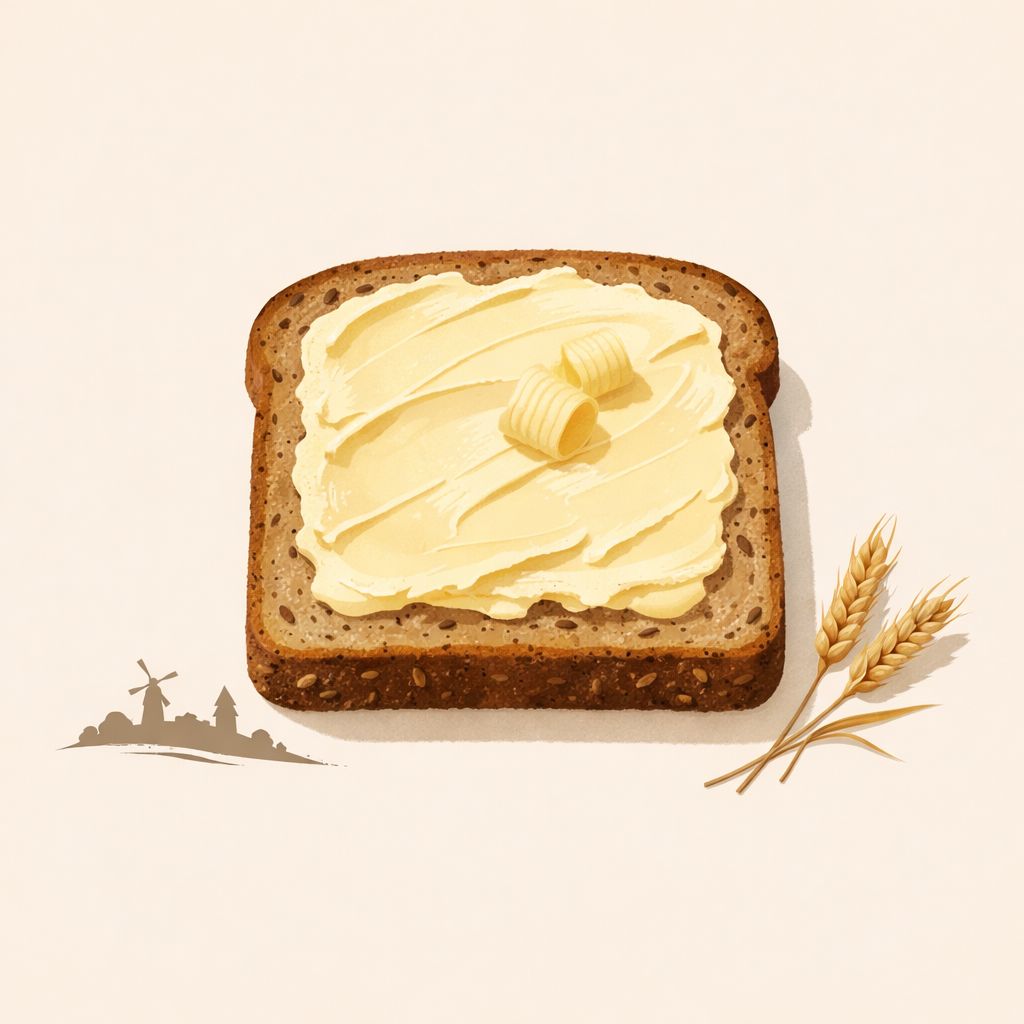
Before it became a cultural idea, a Butterbrot was simply what its name suggests: bread spread with butter. That simplicity is exactly why it matters. Few foods are as ordinary, yet few have carried such a recognizable place in German everyday life.
The Butterbrot has served as breakfast, a school lunch, a meal for workers, an evening supper, and something to eat between meals. It can be completely plain or topped with cheese, sausage, jam, vegetables, or other ingredients. Yet the basic idea remains the same: a slice of bread forms the foundation.
In everyday German, Butterbrot can also refer more broadly to a packed lunch or school sandwich, even when the bread contains much more than butter alone. If someone says, “Vergiss deine Butterbrote nicht” (“Don’t forget your Butterbrote”), they may be talking about the prepared sandwiches packed for school or work rather than several slices of bread with nothing but butter.
For many people, that makes the Butterbrot more than a food. It is part of the visual and emotional vocabulary of German everyday life.
German Bread Culture and the Roots of the Butterbrot
To understand the Butterbrot, it helps to understand the importance of bread in Germany. Bread has never been merely something placed beside a meal. Germany developed an unusually broad regional bread culture, shaped by local ingredients, climate, geography, historical borders, and generations of baking knowledge.
German Bread Culture has been included in Germany’s national inventory of intangible cultural heritage since 2014. The tradition brings together regional diversity, baking knowledge, craftsmanship, customs, and social practices that have developed over centuries.
That background gives the Butterbrot much of its character. The bread itself can change from region to region, while the basic ritual remains remarkably familiar.
A dense rye bread, a mixed-grain loaf, or a lighter country-style bread can all become a Butterbrot. The simplicity of the topping allows the bread to remain part of the experience rather than becoming merely a carrier for other ingredients.
History of the Butterbrot in Germany
The history of bread and butter together reaches back centuries, although it is difficult to assign a single point at which the modern Butterbrot was “invented.” Bread was already a fundamental food in German-speaking regions during the Middle Ages, while butter was produced in areas where dairy farming was established.
The combination made practical sense. Bread was filling and comparatively easy to transport, while butter added richness and calories without requiring a complicated preparation. For ordinary households, a slice of buttered bread could therefore be both useful and satisfying.
There are also early literary references that show how familiar the idea had become. Martin Luther is associated with a 1525 reference to buttered bread as good food for children. Centuries later, Johann Wolfgang Goethe used the image of Butterbrot in The Sorrows of Young Werther, where bread and sour milk appear as part of a simple meal shared with children.
These references do not prove that Butterbrot looked exactly the same in every German household. They do, however, show that buttered bread had become recognizable enough to appear in descriptions of ordinary life.
The Butterbrot and German Everyday Food Traditions
The practical nature of the Butterbrot helped it fit almost effortlessly into everyday routines. It could be prepared quickly in the morning, wrapped for school or work, carried on a journey, or placed on the table for a simple evening meal.
That practicality remains one of its defining characteristics.
German everyday food traditions have long included meals in which bread plays a central role. The Butterbrot does not require a recipe, special equipment, or elaborate preparation. What matters is the quality of the basic ingredients and the way they fit into the rhythm of the day.
It is also worth making a distinction between a traditional Butterbrot and what an American reader might automatically call a sandwich. A Butterbrot is traditionally an open slice of bread. Once additional toppings are added, the word can describe a much wider range of prepared bread slices, but the open-faced format remains strongly associated with the German idea.
Butterbrot Meaning in German Life: Thrift, Modesty, and Memory
The cultural meaning of the Butterbrot goes beyond its ingredients. Its simplicity reflects a broader appreciation for food that is useful, filling, and not unnecessarily complicated.
There is also a strong connection with childhood. For many Germans, the Butterbrot means the food packed for school, the slice prepared before leaving home, or the familiar evening meal waiting in the kitchen. The details differ from family to family, but the pattern is recognizable.
That is where the Butterbrot becomes particularly interesting as a cultural object. A food that requires almost no explanation can still carry a great deal of memory.
It can remind someone of a particular kind of bread from childhood, the way a parent cut a slice, the sound of a lunchbox closing, or the simple routine of sitting down for an evening meal. None of these things are extraordinary by themselves. Together, they give the Butterbrot an emotional significance that goes far beyond bread and butter.
Regional Names for Butterbrot and Local Identity
One of the clearest signs of the Butterbrot’s place in German culture is the number of regional words used for it.
In Berlin and parts of northeastern Germany, Stulle is a familiar term. In Saxony and surrounding areas, Bemme is widely recognized. In the Rhineland and parts of the Lower Rhine, Bütterken is used. Other regions use words such as Knifte, Schnitte, or Butterschmier.
These names are more than linguistic curiosities. They show how an everyday food can become part of local identity.
The basic idea remains recognizable across Germany, but the vocabulary changes with the region. That is typical of German food culture: a food tradition can be broadly national while still carrying very strong local associations.
Abendbrot and the Place of Butterbrot at the German Table
The Butterbrot is closely connected with Abendbrot, literally “evening bread.” In the traditional form of this meal, bread is served with butter and a selection of toppings such as cheese, cold cuts, spreads, vegetables, or other simple accompaniments.
This is an important distinction. The Butterbrot is not simply a snack that happens to be convenient. It belongs to a broader way of organizing meals around bread.
The importance of bread in family and domestic life is also reflected in traditions such as Abendbrot and Brotzeit, which show the close relationship between bread and social life in Germany.
That helps explain why German bread culture is so closely connected with hospitality, family routines, and shared meals. Bread is not merely an ingredient. It can be the center around which a simple meal is organized.
German Bread Culture, Butterbrot Day, and Cultural Recognition
The Butterbrot even has its own annual day. The Tag des Deutschen Butterbrotes, or Day of the German Butterbrot, was introduced in 1999 by the former Centrale Marketing-Gesellschaft der deutschen Agrarwirtschaft (CMA). It was associated with the last Friday of September and has continued to be observed informally even after the CMA was dissolved.
The day itself was originally a marketing initiative, so it should not be confused with an ancient German tradition. What is interesting is that the idea survived because the food already had a place in everyday life.
The much more significant cultural recognition concerns German bread itself. In 2014, German Bread Culture was added to Germany’s national inventory of intangible cultural heritage. The recognition emphasizes not just the enormous variety of breads but also the knowledge, craftsmanship, regional traditions, and social practices surrounding them.
The Butterbrot belongs naturally within that larger culture. It depends on the bread, and the bread gives the Butterbrot much of its regional character.
Why the Butterbrot Still Matters Today
Modern Germany has no shortage of alternatives. Sandwiches, wraps, packaged snacks, breakfast cereals, bakery rolls, and convenience foods have all become part of everyday eating.
Yet the Butterbrot has not disappeared.
Part of its strength is that it does not need to compete with modern food on modern food’s terms. It is quick without being a convenience product, simple without being insubstantial, and familiar without needing to follow a trend.
It also remains remarkably adaptable. A traditional Butterbrot can be nothing more than good bread, butter, and perhaps a little salt. Another might carry cheese and sliced vegetables. A school lunch might include sausage or cold cuts. A sweet version might be spread with jam or honey.
The format changes, but the underlying idea remains remarkably stable.
What the German Butterbrot Says About German Food Culture
Perhaps that is what makes the Butterbrot such an interesting subject. It is not a national dish in the formal sense, and there is no single recipe that defines it.
Instead, it is a habit.
It connects bread with family life, regional language with local identity, and simple food with memory. It shows how a culture can be expressed through something that most people hardly notice because it is so familiar.
The Butterbrot also offers a useful way to understand German bread culture from outside the country. If you only look at famous dishes, you see sausages, pretzels, schnitzel, and regional specialties. Look at what people actually put on the table on an ordinary day, and bread becomes much more important.
That is where the Butterbrot belongs.
It is not grand, and it was never meant to be. Its cultural importance comes precisely from its ordinariness: the repeated act of cutting bread, spreading butter, adding something simple if desired, and sitting down to eat.
In that sense, the Butterbrot is more than bread with butter. It is a small piece of German everyday history that is still being repeated today.
Sources and Further Reading
Deutsche UNESCO-Kommission: Deutsche Brotkultur
Deutschland.de: Das deutsche Butterbrot







2 Comments
Comments are closed.