Bavarian Traditions Explained: From Maypoles to Beer Gardens
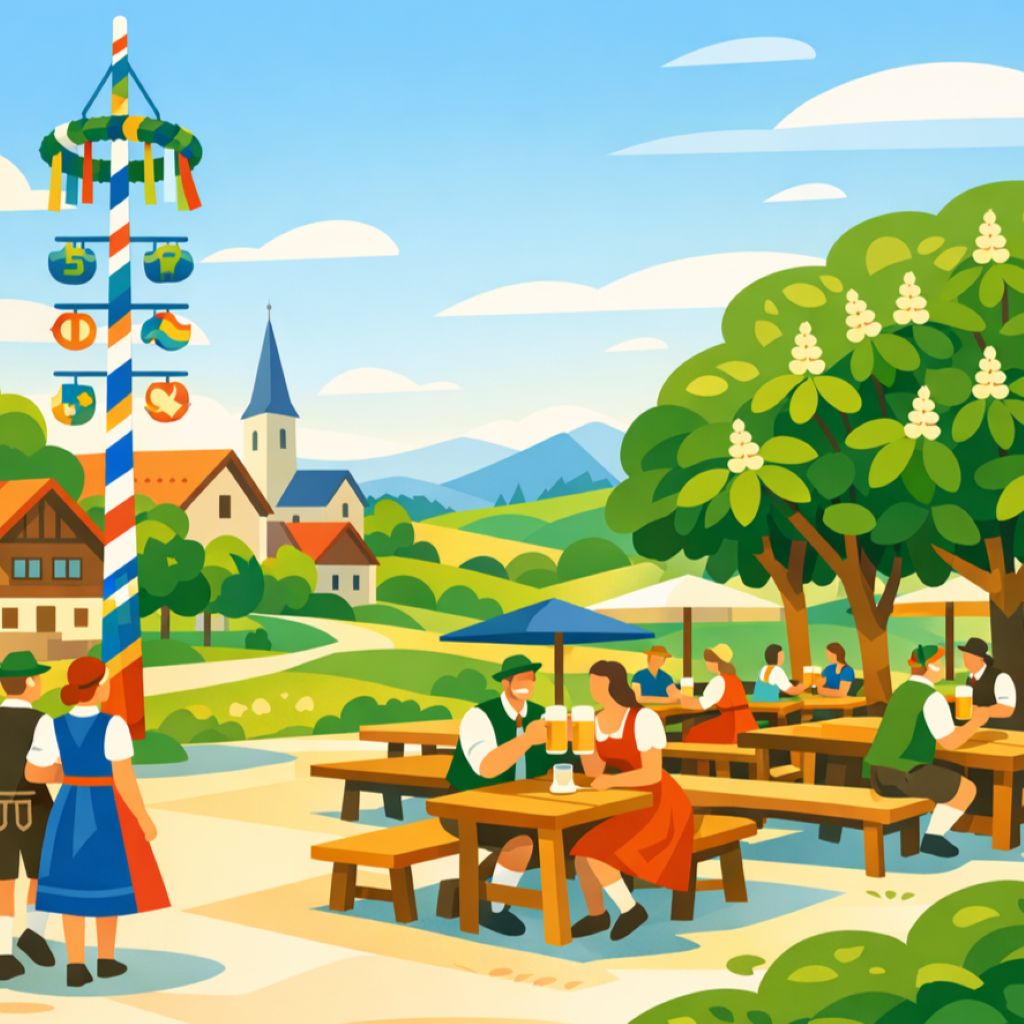
Bavaria is one of Germany’s most distinctive regions, with traditions that are often recognized far beyond its borders. Maypoles, beer gardens, Brotzeit, traditional dress, brass music, and large folk festivals are all part of the picture. But Bavarian culture is more than the familiar postcard images of pretzels and beer.
What I find especially interesting is how many of these traditions are connected to everyday community life. A maypole can represent the identity of an entire village. A beer garden can be as much about sitting together and sharing food as it is about the beer itself. And traditional foods such as Weisswurst are closely connected to the region’s history and customs.
The Maibaum: A Village Tradition in Spring
One of the most recognizable Bavarian traditions is the Maibaum, or maypole. In many Bavarian communities, a tall decorated tree is raised in spring, often on or around May 1.
The design and customs surrounding a Maibaum vary from place to place. Some are elaborately painted and decorated with symbols representing local trades, businesses, clubs, or community life. Raising the tree can involve music, food, dancing, and a gathering of local residents.
The important point is that a Maibaum is not simply a decorative object. It can serve as a visible expression of local identity. The tradition connects the village or town with its history and gives people a reason to come together.
Bavarian Beer Gardens: More Than a Place to Drink Beer
Bavarian beer gardens are another tradition that visitors often associate immediately with the region. Yet the classic beer garden experience is about more than ordering a large glass of beer.
Traditional beer gardens developed as social places where people could sit outdoors under shady trees, meet friends, and spend time together. In some traditional Bavarian beer gardens, guests may also bring their own food while purchasing drinks from the beer garden. This custom is particularly associated with traditional Biergarten culture, although individual establishments can have their own rules.
That distinction is worth knowing because a traditional Bavarian beer garden is not necessarily the same thing as a restaurant with outdoor seating. The atmosphere is often deliberately informal: long tables, shared seating, trees overhead, and people spending time together rather than simply eating a quick meal.
Brotzeit: A Simple Bavarian Way of Eating
The Bavarian word Brotzeit literally combines Brot (bread) with Zeit (time). In practice, it describes a simple meal or snack centered around bread and savory foods.
A traditional Brotzeit might include bread, cheese, cold cuts, sausages, radishes, pickles, mustard, and other simple accompaniments. The exact selection depends on the occasion and region.
Brotzeit fits naturally into Bavarian social life because it is easy to share. It can be eaten at home, during a gathering, or in a beer garden. The emphasis is not on elaborate preparation but on good, straightforward food enjoyed together.
A plate of pretzels is another familiar part of this food culture, especially when bread and savory accompaniments are being shared around a table.
Weisswurst and Bavarian Food
Few foods are as strongly associated with Munich and Bavaria as Weisswurst, the traditional pale sausage made from finely minced meat and seasoned with herbs and spices.
Weisswurst is particularly associated with Munich and the surrounding Bavarian food culture. It is traditionally served warm, often together with a fresh pretzel and sweet Bavarian mustard.
The sausage has also become an excellent example of why regional food traditions should not automatically be treated as everyday habits throughout an entire country. Weisswurst is an important Bavarian specialty, but that does not mean every German eats it regularly.
How Is Weisswurst Traditionally Eaten?
There is one small piece of Bavarian food etiquette that can surprise visitors from outside Germany: the casing of a traditional Weisswurst is not normally eaten.
There are different ways to remove the casing. Some people make a lengthwise cut and lift the sausage out, while the traditional Munich method known as Zuzeln involves eating the sausage from the casing without actually biting through it.
You may also hear the old rule that Weisswurst should be eaten before noon, traditionally described as being served before the church bells ring at twelve. This is part of the historical Munich tradition surrounding the sausage rather than a rule that every Bavarian follows today.
Traditionally, Weisswurst is served with sweet Bavarian mustard and a pretzel. That combination is much more useful to remember than trying to memorize a long list of rules: a warm Weisswurst, sweet mustard, and a fresh pretzel give you a very good introduction to this particular Bavarian food tradition.
Dirndl, Lederhosen, and the Meaning of Tracht
Traditional Bavarian clothing is another part of the region’s cultural identity. The Dirndl and Lederhosen are internationally recognizable, but they are better understood as forms of Tracht than simply as “Bavarian costumes.”
Tracht refers to traditional clothing associated with particular regions and communities. Styles can differ considerably, and historical clothing traditions are more varied than the modern tourist image might suggest.
Today, Dirndl and Lederhosen can be seen at folk festivals, weddings, traditional celebrations, and other special occasions. They are not everyday clothing for most Bavarians.
This is another useful distinction when looking at Bavarian culture from outside Germany. Traditional clothing remains visible and meaningful, but its role depends very much on the occasion.
Volksfeste and Kirchweih: When the Community Celebrates
Bavarian traditions also come alive during Volksfeste, or traditional folk festivals. These events can include fairground rides, food stalls, music, dancing, beer tents, and local traditions.
Not every Volksfest is an Oktoberfest. Many Bavarian towns and villages have their own annual festivals, often connected with local history, religious celebrations, harvest traditions, or the community’s Kirchweih.
Oktoberfest is the most internationally famous example, but the broader Bavarian tradition of local Volksfeste is much larger. Smaller celebrations can offer a more local view of Bavarian life than the famous Munich festival, with families, local clubs, musicians, and community organizations all having a role in keeping traditions alive.
Oktoberfest Is Bavarian, But Bavaria Is Much More Than Oktoberfest
Oktoberfest is undoubtedly one of Bavaria’s most famous traditions. Held in Munich, it has become an international event attracting visitors from around the world.
But it represents only one part of Bavarian festival culture. Bavaria has countless smaller folk festivals, beer festivals, church fairs, seasonal celebrations, and local events that are far more connected to everyday community life.
That is why I think it is useful to look beyond Oktoberfest when trying to understand Bavaria. The big festival is spectacular, but the smaller traditions often tell you more about how local culture is maintained from one generation to the next.
Why Bavarian Traditions Still Feel Alive
One reason Bavarian traditions remain so visible is that many of them are not simply historical reenactments. They are still part of community life.
A village may raise its Maibaum, local clubs may organize a festival, families may meet for a Brotzeit, and people may wear traditional clothing for a special occasion. These customs can change over time without disappearing completely.
At the same time, Bavaria is a modern region with large cities, international businesses, universities, and a diverse population. Traditional culture exists alongside contemporary life rather than replacing it.
That combination is what makes Bavarian traditions interesting. They are not frozen in the past. They continue to adapt while remaining recognizable.
Seeing Bavaria Beyond the Postcard
For visitors, Bavaria can initially seem almost too familiar: the Alps, pretzels, beer, Dirndl, Lederhosen, and Oktoberfest are images that have been used around the world to represent Germany.
But the real Bavarian story is more local and more varied. It can be found in village traditions, regional foods, community festivals, seasonal customs, and the simple habit of sitting together over a meal or a drink.
That is the side of Bavaria I find most interesting. The traditions are not important simply because they look typically Bavarian. They matter because people continue to give them a place in everyday life.
Bavarian customs vary by region, community, and occasion. Traditions described here should not be understood as practices followed by every person throughout Bavaria.