Christmas Trees in Germany: From the Tree Stand to the Living Room
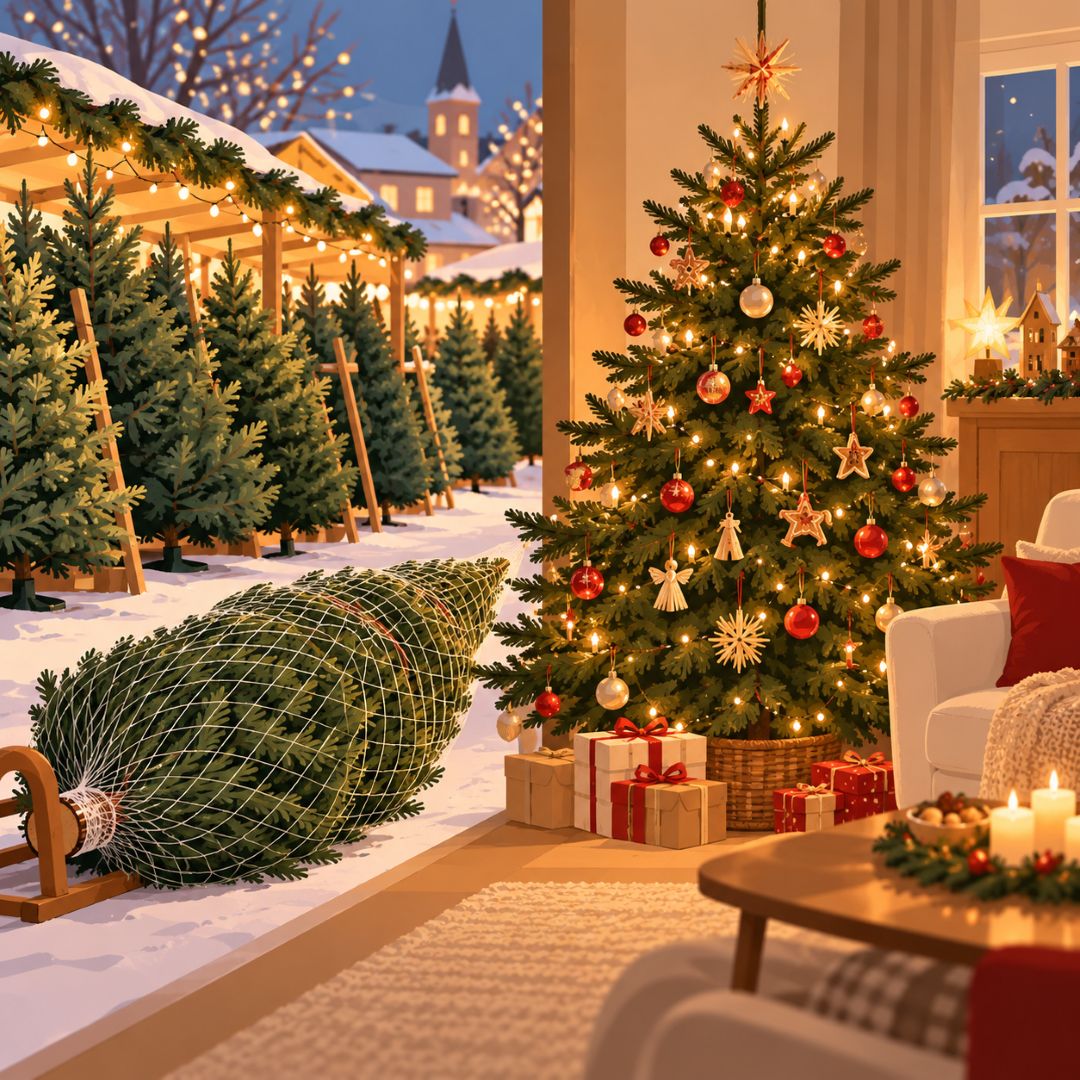
There is a moment every December when Christmas suddenly feels much closer: the first Christmas tree stands appear.
In Germany, you may see them outside garden centers, supermarkets, local businesses, or right at a Christmas tree farm. Rows of real trees stand outdoors, waiting for families to walk around them, compare their shapes, and find the one that feels just right.
For many families, buying the Christmas tree is more than a practical errand. It is part of the season itself. The smell of fresh evergreen branches, cold winter air, and a tree waiting to be taken home can make Christmas feel very real.
And once the tree comes through the front door, the next part of the tradition begins: finding the right spot, keeping it fresh, adding the lights, and finally decorating it.

Where Germans Buy Their Christmas Trees
Christmas trees are sold in many different places during the Advent season. Some families buy theirs from a local Christmas tree farm, while others choose a temporary sales stand near a supermarket, garden center, or another convenient location.
At a farm, you may even have the opportunity to choose a tree while it is still growing in the field. Some growers offer self-cutting days, turning the purchase into a small family outing. Other farms have large areas of freshly cut trees where you can walk around and choose your favorite.
At many sales locations, the tree can be prepared for transport. The trunk may be trimmed to fit a tree stand, and the tree can be wrapped in a net to make the trip home easier.
That part is particularly useful because a beautiful Christmas tree can be surprisingly awkward to carry. A netted tree is much narrower and easier to transport than the same tree with all its branches spread out.
Which Christmas Tree Do Germans Choose?
If you visit a German Christmas tree stand, you will usually see several types of evergreen trees. They may look similar from a distance, but their needles, branches, fragrance, and ability to stay fresh can be quite different.
Nordmann Fir
The Nordmann fir is by far the most popular Christmas tree in Germany. It has soft, dark green needles that do not usually feel sharp when you decorate the tree. It also holds its needles very well, which makes it a practical choice for a tree that will stay indoors throughout the Christmas season.
There is one thing the Nordmann fir does not provide in abundance: that strong Christmas-tree smell many people associate with evergreens. Its low resin content means that the fragrance is relatively subtle.
For families who want a beautiful tree that is comfortable to decorate and does not quickly cover the floor with needles, the Nordmann fir is an easy favorite.
Blue Spruce
The blue spruce has a very different personality. Its needles can have a striking blue-green or silvery appearance, and its branches are strong enough to support heavier ornaments.
The trade-off is the needles. They are much sharper than those of a Nordmann fir, so decorating a blue spruce can require a little more care. It also offers more of the fresh, resinous fragrance many people expect from a traditional Christmas tree.
Norway Spruce
The Norway spruce has a long history as a Christmas tree in Germany. It has a lovely evergreen fragrance and can be a more affordable choice.
However, it does not hold its needles as well as a Nordmann fir, particularly in a warm indoor room. If you choose a spruce, keeping it well supplied with water and away from direct heat becomes especially important.
There are other varieties as well, including noble firs and several less common types. That variety is part of what makes choosing a real tree so much more interesting than simply picking a standard shape from a box.
How Do You Know if a Christmas Tree Is Fresh?
A fresh tree should look fresh when you buy it. The needles should have a healthy appearance, and the cut surface at the bottom of the trunk should not look excessively dry or gray.
Another simple clue is how the needles feel and behave. If a tree is already dropping large numbers of needles at the sales stand, that is not a good sign.
The tree’s freshness also depends on what happens after you bring it home. Even a freshly cut tree will eventually dry out. Warm rooms, dry air, and a location directly beside a radiator or fireplace can speed up the process.
That is one reason the timing of the purchase matters. A tree that will stand in the living room for several weeks needs to cope with a much longer indoor stay than one bought shortly before Christmas.
Do Christmas Trees Need Water?
Yes. A fresh-cut Christmas tree can take up water through the cut end of its trunk, so a suitable tree stand with a water reservoir can help it stay fresh longer.
Check the water level regularly, especially during the first days after bringing the tree inside. A freshly cut tree can use more water than you might expect.
It is also a good idea to let the tree adjust before decorating it. If it has been outside in the cold, bringing it directly into a very warm room creates a sudden change in temperature. A cooler transitional space, when available, can make the move indoors gentler.
And keep the tree away from direct heat. A beautiful Christmas tree may look wonderful beside a fireplace, but heat dries out the branches much faster.
Will Hairspray Stop the Needles From Falling?
This is one of those Christmas tips that sounds clever until you think about it for a moment.
No, hairspray is not a good way to keep a Christmas tree fresh.
Hairspray does not replace the things a cut tree actually needs. It does not prevent the tree from drying out, and adding a flammable spray to a tree that will be surrounded by electrical decorations or possibly open flames is not a sensible shortcut.
If you want your tree to keep its needles as long as possible, focus on the basics instead: start with a fresh tree, give it access to water, and keep it away from direct sources of heat.
Sometimes the simplest Christmas advice really is the best.
How Do Germans Decorate the Christmas Tree?
There is no single decorating style that every German family follows. Some trees look traditional and colorful, while others use only a few carefully chosen decorations.
Still, there is something wonderfully familiar about the moment when the Christmas decorations come out of their boxes.
Many families begin with the lights. An electric string of lights can be placed throughout the branches so that the tree glows from the inside as well as from the outside.
After that come the ornaments. Larger decorations can fill the deeper spaces between the branches, while smaller ornaments work well toward the outer edges. The goal is usually not to make every branch identical. A real tree has its own shape, and the decorations work with it.
Then comes the very top.
What Goes on Top of a German Christmas Tree?
The tree topper is often one of the final details to go onto the Christmas tree. A star is a popular choice, as is a traditional tree finial or another decorative topper.
Some families use the same topper every year. Others have several and choose a different one depending on the tree or the decorations.
There is no rule that says a German Christmas tree has to look a certain way. That is worth remembering when looking at photographs of beautifully decorated trees online. Real family trees are usually much more personal.
A slightly uneven branch, an ornament that has been part of the family for years, or a handmade decoration from a child can be much more meaningful than a perfectly coordinated display.
What About Real Candles?
Real candles have a long history in German Christmas traditions. They create a beautiful, warm glow, and the sight of candlelight on a Christmas tree is deeply connected with older Christmas customs.
Today, however, electric Christmas lights are the safer and much more practical choice for most homes.
A dry Christmas tree is highly flammable, and the risk increases as the tree loses moisture. German fire safety organizations strongly warn about the danger of open flames around drying Christmas greenery. Electric lights are therefore the sensible everyday choice, especially in homes with children or pets.
If someone does choose to use real candles, they need constant attention and careful placement. A burning candle should never be left unattended, even for a short time.
For me, there is something lovely about the fact that modern Christmas trees can still have that warm candlelit feeling without actually putting flames into the branches. A soft string of warm white lights can make a room feel wonderfully cozy.
Real or Artificial Christmas Tree?
Not every German household chooses a real Christmas tree, of course. Artificial trees are also an option, especially for people who want something convenient that they can use year after year.
An artificial tree does not need watering, does not drop needles, and can be packed away after Christmas. It also makes it easier to keep the same shape and size from one year to the next.
A real tree offers something different. Every tree has its own shape, its own branches, and its own natural fragrance. Buying it can become part of the Christmas ritual, particularly when the tree comes directly from a local grower.
Neither choice has to be the “right” choice for everyone. A family that loves the tradition of choosing a fresh tree may prefer a real one. Another family may appreciate the convenience of an artificial tree. Christmas traditions have always changed with the way people live.
The Beauty of an Imperfect Tree
I have always liked the fact that a real Christmas tree does not have to be perfect.
It may have one side that is fuller than the other. One branch may reach farther out than expected. The top might lean slightly to one side until you find the right position for it.
And somehow, those little imperfections make the tree feel more like part of a home.
Once the lights are on and the ornaments are hanging, you stop noticing whether the shape is perfectly symmetrical. You notice the little things instead: the ornament that has been used for years, the decoration a child made at school, or the first light that comes on in the dark winter afternoon.
When Does the Christmas Tree Come Down?
Christmas trees do not all leave German living rooms on the same day. Some families take them down shortly after New Year’s, while others keep them a little longer.
One practical point is important, though: a tree becomes increasingly dry as time passes, even when it has been watered. Once the branches and needles have dried out significantly, the fire risk increases. That is one reason families should not keep a very dry tree indoors simply because they are not ready to say goodbye to Christmas yet.
After Christmas, many German towns and communities organize Christmas tree collection days. The exact system varies from place to place, but the familiar sight of discarded trees waiting outside for collection is part of the post-Christmas landscape.
From a Simple Tree to a Christmas Home
Perhaps that is what I like most about the German Christmas tree tradition. It begins with something wonderfully ordinary.
You walk among real trees at a cold outdoor stand. You look at the height, the shape, the branches, and the needles. You finally point to one and say, “That one.”
Then it comes home.
For a little while, it may simply stand in the corner of the living room while everyone decides exactly where it belongs. Then the lights come out. The ornaments are unpacked. Someone finds the tree topper. Maybe Christmas music is playing in the background.
And suddenly, it is no longer just a tree.
It is the Christmas tree.
That small transformation is one of my favorite parts of the season.
Christmas greetings,
Mary