View from Television Tower in Berlin-Mitte
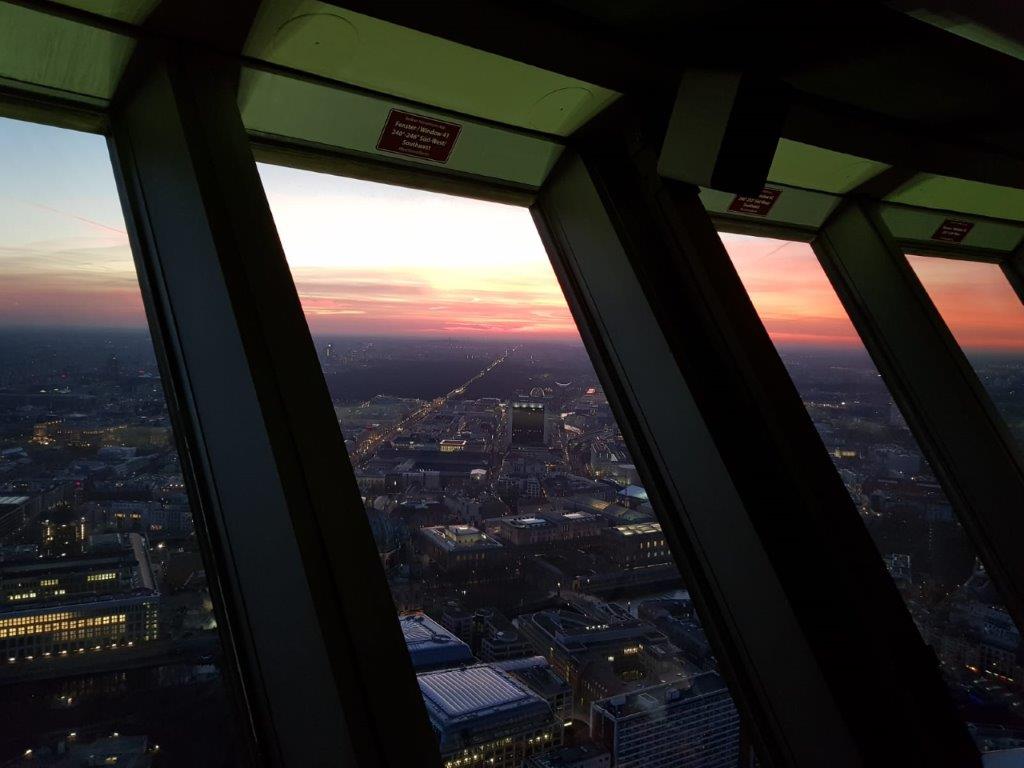
The Berlin TV Tower is one of the city’s most recognizable landmarks. Rising above Alexanderplatz in Berlin-Mitte, the Fernsehturm offers a completely different way to see the German capital. From high above the city, familiar streets, historic buildings, parks, and neighborhoods become part of one wide Berlin panorama.

Seeing Berlin from Above
The Fernsehturm was built in the 1960s in what was then East Berlin. At 368 meters, it remains the tallest structure in Germany and has become an unmistakable part of the Berlin skyline.
The tower was constructed as a television broadcasting facility, but its striking appearance quickly made it much more than a technical structure. Its spherical observation and restaurant area became one of the most recognizable features of the Berlin skyline.
From the ground, the tower dominates Alexanderplatz. From above, the perspective changes completely. Berlin seems to spread out in every direction, with the city’s different districts forming a large urban landscape.
The View Over Berlin-Mitte
Looking down toward Berlin-Mitte, Alexanderplatz is one of the easiest places to recognize. The square and its surrounding streets form a busy part of central Berlin, while the Fernsehturm itself stands directly beside them.
From this height, many of the details that seem important at street level become part of a much larger picture. Roads turn into lines through the city, buildings form blocks, and parks appear as large areas of green between the urban neighborhoods.
This is one of the things I like about viewing a city from above. You begin to understand how the different parts of Berlin fit together.
Berlin’s History in the Distance
A view from the Fernsehturm is not only about modern Berlin. Looking across the city, you can also see places connected with its long and often complicated history.
The Reichstag, for example, is recognizable by its distinctive glass dome. The building has played an important role in German political history and today houses the German Bundestag.
The broad green area of the Tiergarten provides another strong contrast. The park lies between the historic center and the western parts of Berlin and is one of the city’s largest green spaces.
Farther away, the Olympic Stadium can also be seen on a clear day. Its history reaches back to the 1936 Olympic Games, one of the most politically charged sporting events of the 20th century.
Alexanderplatz and the Fernsehturm
The relationship between Alexanderplatz and the television tower is an important part of the character of this part of Berlin.
Alexanderplatz had already been an important urban square before the tower was built. During the period of East Germany, however, the area was extensively redesigned, and the Fernsehturm became the dominant landmark of the new cityscape.
Today, the combination of the historic square, later East Berlin architecture, public transportation, shops, and the television tower makes Alexanderplatz one of the most recognizable places in Berlin.
The Sphere and the View
The sphere near the top of the Fernsehturm contains the visitor areas and restaurant. Its position high above Berlin makes the experience different from a conventional city restaurant.
The view is constantly changing as you look toward different parts of the city. On a clear day, the urban landscape extends far beyond the immediate surroundings of Alexanderplatz.
For me, this is the real attraction of the Fernsehturm. The tower is impressive from the outside, but the view gives it a completely different meaning. Instead of simply looking at the landmark, you are looking out from it.
Berlin from a Different Perspective
Berlin can sometimes feel like a collection of very different cities. Historic streets, large modern buildings, quiet residential neighborhoods, parks, former industrial areas, and places shaped by the division of the city all exist within the same urban landscape.
From the Fernsehturm, those differences become easier to see. The distance between places that seem separate when walking through the city suddenly becomes much clearer.
You can also get a better feeling for how much green space Berlin contains. The city is not simply a dense collection of buildings. Parks, trees, waterways, and open spaces are visible throughout the panorama.
A Different Way to Experience Berlin
There is something special about seeing a familiar city from above. Places that you may have visited many times from street level can suddenly look completely different.
The Fernsehturm offers exactly that perspective. It connects the modern Berlin skyline with the city’s history below, from Alexanderplatz and the former East Berlin to the historic center and the broad green spaces beyond.
If you are interested in Berlin beyond its best-known landmarks, you may also enjoy our article about the historic town hall in Berlin-Spandau. It offers a very different view of the city and its history.
Looking Across Berlin
Standing high above Berlin changes the way the city feels. From the ground, the Fernsehturm is a landmark that helps you find your way around. From the tower, the entire city becomes the view.
For me, that is what makes the Fernsehturm particularly interesting. You are not simply looking at Berlin’s skyline. You are looking at a city shaped by centuries of history, dramatic political changes, reunification, and everyday life.
And when you return to street level at Alexanderplatz, Berlin looks a little different because you have seen it from above.
A view over Berlin-Mitte from the Fernsehturm at Alexanderplatz.
Sources & References
Background information about the Berlin TV Tower: Berlin.de – Berlin TV Tower